BY JOHN HOUANIHAU
Wayne Ghemu, Minister for the Ministry of Environment, Climate Change, Disaster Management and Meteorology (MECDM) has thanked the Government of the People’s Republic of China and the Chinese Embassy for their continued support and partnership with Solomon Islands, particularly in advancing renewable energy.
Mr Ghemu made the remarks on Monday 24 August during the signing ceremony for the second phase of the mini solar power project, which will extend clean energy access to the remaining 25 constituencies across the country.
He said China’s commitment to supporting renewable energy development in Solomon Islands was deeply valued, noting that the partnership would contribute to practical benefits for communities.
“First and foremost, I would like to express my sincere appreciation to the Government of the People’s Republic of China, through Your Excellency and the Chinese Embassy, for their continued support and partnership with Solomon Islands,” Ghemu said.
He said access to clean and affordable energy would help communities reduce their reliance on expensive imported fossil fuels while providing more reliable and sustainable power.
Ghemu highlighted the wider benefits of renewable energy, saying improved access to electricity would support community services, small businesses, education, healthcare and economic opportunities.
He also stressed that addressing climate change and achieving sustainable development required collective action and strong partnerships between countries.
“No country can do it alone,” he said.
Ghemu said partnerships such as the cooperation between Solomon Islands and China provided an opportunity for countries to share knowledge, provide mutual support and work together towards building more resilient communities.
He encouraged constituencies involved in the solar project to remain committed to its successful implementation so that the benefits could reach the people it was intended to serve.
The Minister said he looked forward to seeing the positive impact of the mini solar power project on communities and the country as a whole.
Chinese Ambassador to Solomon Islands Cai Waiming also reaffirmed China’s commitment to strengthening bilateral relations with Solomon Islands at the ceremony.
He said cooperation between the two countries had continued to deliver tangible benefits since diplomatic relations were established in 2019.
China said it was willing to further align its development cooperation with Solomon Islands’ priorities and deepen cooperation across various fields for the benefit of both countries.
For feedback, contact: jhouanihau24@gmail.com
Editor: irwin2angiki@gmail.com
BY DOUGLAS VAHIA
THE Ministry of Commerce, Industry, Labour and Immigration (MCILI), in partnership with the Central Bank of Solomon Islands (CBSI), has officially reopened the SME Credit Guarantee Scheme (SMECGS).
The scheme was reopened at a ceremony held at the MCILI Conference Room today, August 27.
Minister Harry Kuma said the GREAT Coalition Government considers access to finance critical to private sector growth.
He referred to the recently released World Bank Economic Update for Solomon Islands, which recommends strengthening financial intermediation towards productive sectors.
Minister Kuma said access to affordable finance remains a major challenge for local businesses, particularly small and emerging enterprises that lack sufficient collateral.
He said SMECGS allows the Government to share lending risks with participating financial institutions, giving viable businesses a better opportunity to access credit.
Minister Kuma urged participating banks to resume nominations and submissions under the scheme and called on micro, small and medium enterprises (MSMEs) to use the facility responsibly.
He said the objective was not simply to provide loans, but to help businesses invest, expand, create jobs and contribute to economic growth.
CBSI Deputy Governor Raynold Moveni said the scheme was suspended in January 2025 after the Government’s guaranteed commitments grew beyond available funding.
He said the challenges faced by MSMEs were not simply due to a lack of financial schemes, but also reflected gaps in the design of existing programmes.
Mr Moveni said these gaps often failed to take into account the specific needs of small businesses, particularly youth- and women-owned enterprises, which have recorded low uptake of existing schemes.
He pointed to recommendations from a recent MSME survey, including simplifying loan applications, adopting risk-based lending strategies, introducing flexible repayment options and strengthening financial literacy through closer cooperation between Government and financial institutions.
Mr Moveni confirmed that CBSI was ready to administer the scheme in line with the agreed framework and work with Government, financial institutions and other stakeholders to ensure it delivers practical and accountable outcomes.
He commended the Government for recognising that the potential of Solomon Islanders to grow their businesses should not be limited solely by a lack of collateral.
The reopening of SMECGS marks a renewed partnership between Government, CBSI, financial institutions and the private sector to expand access to finance for small and medium enterprises.
For feedback, contact: diivee56@gmail.com
Editor: irwin2angiki@gmail.com
BY NED GAGAHE
The Faculty of Education and Humanities (FEH) and the SEWA Student Association have been recognised for their outstanding contributions to the Solomon Islands National University (SINU) Open Day 2026.
FEH won the Best Booth Award for its presentation, featuring a coconut tree-inspired design and a Tomoko canoe from Western Province to represent unity and cooperation.
The SEWA Student Association received the Best Cultural Performance Award for its panpipe performance, which showcased Solomon Islands culture and student talent.
Representatives of FEH and SEWA received their certificates on Monday, August 24, in recognition of their achievements during the Open Day held on Friday, August 21, at the SINU Kukum Campus.
The event was held under the theme, “Creating Your Future: Education, Skills and Innovation for a GREAT Solomon Islands.”
It brought together students, parents, schools, industry partners, Government representatives and members of the public to explore SINU’s academic and technical programmes, research, innovation and student support services.
The Open Day featured information booths, campus tours, a flag-raising ceremony, speeches and cultural and contemporary performances.
Hundreds of visitors, including secondary school students from across Honiara, attended the event to learn more about study, training and development opportunities available at SINU.
SINU thanked its students, staff, schools, partners, performers and members of the community for contributing to the success of Open Day 2026.
For feedback, contact: nedgagahe@gmail.com
Editor: irwin2angiki@gmail.com
By Gardner Absolom
The Solomon Islands Government is preparing to roll out its fully funded education initiative, which will eventually support 1,000 students to pursue study opportunities in China.
Minister for Education and Human Resources Development, Steven Kumi, announced the initiative at the 2026 Chinese Government Scholarship Awards Ceremony earlier this week.
Minister Kumi said the first 200 students are expected to travel to China later this year, with the programme set to expand to 1,000 students in 2027.
“This government initiative will send its first group of 200 students to China later this semester, laying the groundwork to scale up to 1,000 students next year,” Minister Kumi said.
He said the programme will provide both degree and non-degree study opportunities, with a focus on areas critical to Solomon Islands’ national development.
These priority areas include agriculture, fisheries, forestry, healthcare, roads and infrastructure, renewable energy, and information technology.
Minister Kumi said the initiative will contribute to developing a skilled workforce equipped with the knowledge and expertise needed in key national priority areas.
ENDS//
The post Government Prepares for 1,000-Student Fully Funded Initiative first appeared on Solomon Islands Broadcasting Corporation (SIBC) .
BY JOSES SAREN
More than 40 Solomon Islands students received Chinese Central and Provincial Government scholarships for 2026 at a ceremony at the Chinese Embassy, Solomon Islands, on August 25.
The recipients will study at more than 30 universities across China in fields ranging from medicine and agriculture to software engineering and business administration, Chinese Ambassador Cai Weiming said at the award ceremony.
Solomon Islands students pose with their scholarship certificates at the 2026 Chinese Scholarship Award Ceremony at the Chinese Embassy, Solomon Islands. Photo Chinese Embassy, Solomon Islands.
They will join around 200 Solomon Islands students already studying in China, the Ambassador said.
Ambassador Cai congratulated the scholarship recipients and their families for the achievement.
He said education was about giving young people the skills, confidence and opportunities to build a better future, and that this was the spirit behind the bilateral scholarship cooperation.
The Ambassador said many former scholarship recipients had gone on to become professionals in their fields, develop global perspectives through cross-cultural exchange, and contribute to their home country through careers in research, business, public service and education.
He urged the new recipients to treasure the opportunity to study in China, work hard, and make the most of their time there.
Ambassador Cai also encouraged the students to broaden their perspectives once they arrive, to travel and see more of the country beyond their host city, and to serve as cultural ambassadors between China and Solomon Islands.
He said the two countries’ shared Austronesian heritage, tracing back to migrations from China’s southeastern coast to the Pacific, was a foundation for that cultural exchange.
The Ambassador said China-SI relations had achieved tangible results since diplomatic ties were established in 2019, and welcomed the new Solomon Islands Government’s commitment to the one-China principle.
He said China’s policy toward Solomon Islands remained guided by what he called the “4 fully-respect principle” — respecting the country’s sovereignty, independence, will, culture and traditions, as well as Pacific island countries’ efforts to seek strength through unity.
For feedback, contact: josessaren@gmail.com
Editor: irwin2angiki@gmail.com
BY BEN BILUA
Gizo
TO reach Keigold village on the rugged Weathercoast of Ranongga Island, you must first conquer the sea.
There is no proper wharf to welcome visitors.
Instead, boats approach the shoreline cautiously, passengers watching the waves before making the difficult decision to jump into the water and wade ashore.
Then comes the second challenge.
From the seaside, a narrow footpath climbs steeply towards the village — more than 735 steps carved into the landscape.
Last steps to the village. Photo Ben Bilua.
For visitors, the climb can feel endless but for the people of Keigold, these steps are more than a pathway.
These are a daily reminder of how far the community has travelled physically and emotionally to build a new life after disaster.
High in the mountains of Ranongga, surrounded by valleys, streams and thick forest, lies a vibrant community of more than 400 people.
Keigold is a village shaped by hardship, tradition and resilience.
Its story began nearly two decades ago when the devastating earthquake and tsunami of 2007 forced families from their former home at Mondo.
Mr Aldrin Jacob.
Aldrin Jacob still remembers the terrifying moments when the earth began to shake.
“It was like the world was going to end. I could not stand straight,” he recalled.
Two people from the community died during the earthquake and tsunami.
The disaster changed everything.
Within days, families began searching for safer ground.
About half of the people from Mondo moved inland, climbing towards higher ground and settling in a valley surrounded by mountains.
What began as a temporary camp slowly became a permanent home.
Houses were built, gardens were planted, a church was established, then came a school and a clinic.
Part of Keigold village. Photo Ben Bilua.
Years later, Keigold had become a village of its own.
“Living up here in the mountain surrounded by valleys, streams and the forest feel much safer than when we lived at Mondo,” Jacob said.
For many families, the mountain became more than a place of refuge.
It became home.
A life without money.
Life in Keigold moves at a different pace.
There are no busy streets, no shipping services and no reliable communication network connecting the community to the outside world.
Main source of income is; copra and selling of fresh vegetable and root crops at Gizo Market. There is no wharf to support economic activities. Yet, somehow, life continues.
For months, families can survive with little or no cash because they understand the land around them.
They know where to plant, when to harvest, which foods can sustain a family and where to find them.
Traditional knowledge remains one of the community’s greatest assets.
People work their gardens, fish, gather food from the forest and depend on the resources around them.
It is a simple way of life, but it is not an easy one.
Children of Keigold
Keigold residents have learned to survive by relying on their instincts, hard work and knowledge passed down through generations.
Concrete houses, iron roofs and large water tanks stand among the green landscape, quietly telling another story.
The people may live far from modern conveniences, but they are not defeated by isolation.
They have adapted. They have built. They have endured. For years, the community enjoyed a relatively peaceful life on the mountain.
Then Cyclone Maila came.
Jacob described Maila as one of the strongest cyclones to hit Ranongga in more than 50 years.
Its winds tore through the community, destroying homes, gardens and fruit trees.
“Maila hit us hard. Houses were blown down, fruit trees fell and gardens were trashed by fallen trees. But the good news is, no one died,” he said.
The absence of deaths brought relief, but the destruction left another painful problem — livelihoods.
Chief of Keigold village. Photo Ben Bilua.
Coconut trees and other fruit trees that families depended on for income were destroyed.
Copra production, one of Keigold’s main sources of cash, was badly affected.
Market opportunities also declined.
“Our coconuts and fruit trees that we used to get money from are now dead. The struggle is real for many families who are looking for school fees for their children,” Jacob said.
It is certain that recovery will not happen overnight for people of Keigold.
Trees that took years to mature must grow again. Gardens must be replanted. Families must rebuild houses and livelihoods.
For a community already living far from markets and basic services, the journey towards recovery is likely to be long.
A clinic fighting isolation.
Keigold has a school and a clinic — two essential services that connect the community to the outside world.
The clinic, co-funded by the Japanese Government and the Solomon Islands Government, provides basic health services to people living in the remote community.
But the clinic itself is struggling with isolation.
Nurse Gracenah Rolland said the distance between Keigold and Gizo Hospital, as well as the nearest Area Health Centre at Koroivuku, makes emergency referrals difficult.
“For emergency cases, we refer our patients to Koroivuku Area Health Centre and from there critical cases can be referred to Gizo Hospital,” she said.
The problem is getting sick patients there. The clinic does not have a boat dedicated to transporting patients.
Instead, Rolland and relatives of a sick patient must search for boat owners whenever an emergency arises.
An elderly woman at Keigold village. Photo Ben Bilua.
“We don’t have transport readily available just for clinic runs. We hunt for boat owners to transport patients to Koroivuku,” Rolland said.
She believes a boat and engine dedicated to the clinic would make a major difference.
But transport is not the clinic’s only challenge.
For years, the clinic has operated without a proper lighting system.
Patients, including pregnant women and newborn babies, have had to rely on their own solar lights.
“This clinic has been without a proper lighting system for a long time,” Rolland said.
For health workers, the problem becomes particularly serious at night.
Emergency treatment requires adequate lighting. Pregnant women giving birth need proper visibility. Newborn babies require careful monitoring.
“What we need is a proper solar lighting system,” Rolland said.
The clinic also needs a reliable water supply.
At present, a small tank collects rainwater, which is used by both patients and health workers.
Rolland is appealing to authorities, organisations and potential donors to help provide solar lighting, additional water storage and a safe and reliable source of drinking water.
For a remote community, these may appear to be simple requests.
But at Keigold, they can mean the difference between struggling through an emergency and receiving safe and timely care.
Footpath to Keigold Village. Photo Ben Bilua.
The road home
The 735 steps leading to Keigold are perhaps the best symbol of the village.
Every day, people climb them carrying food, supplies and sometimes the burdens of life.
The path is steep. The sea below can be unpredictable. The village itself remains isolated.
But at the top of those steps is something visitors may not expect.
There is life. There is laughter. There are children going to school. There are families tending their gardens.
There are churches, homes and people working to rebuild what Cyclone Maila destroyed.
There is also a deep sense of community.
Keigold may appear to be a place separated from the modern world, but its people have built a way of life that works for them.
They have survived an earthquake and tsunami.They rebuilt their lives in the mountains. They endured Cyclone Maila. And now they are beginning the long task of rebuilding again.
Getting to Keigold is not for the faint-hearted. You must brave the sea. You must wait for the right wave. You must jump ashore when the boatman tells you. Then you must climb 735 steps.
And beyond the treacherous shoreline and steep mountain path lies a community that tells a powerful story about survival.
A place once created out of fear has become a home filled with hope.
And somewhere at the end of those 735 steps, beyond the mountains and valleys, Keigold continues to breathe — vibrant, resilient and alive.
For feedback, contact: maetuana777@gmail.com
Editor: irwin2angiki@gmail.com
BY LESLEY FOINAGWA IN WEST KWAIO
Community members in West Kwaio, Malaita Province, have been encouraged to record their customary land rights to protect their land for future generations.
The message was shared during a customary land recording awareness programme held at Geaidingale Community High School on Friday, 21 August 2026. The programme was organised by the Ministry of Lands, Housing and Survey.
Land Recording Officer David Oroi told participants that recording customary land was an important way to protect their rights.
“Securing your land rights today for tomorrow,” Mr Oroi said.
He explained that customary land recording involves documenting land rights and keeping the information at provincial and central land recording offices.
The records include the name of the land-holding group, its genealogy and members, land boundaries, primary and secondary rights, and the names of representatives.
Mr Oroi said the process was important for tribes, government, communities, women and young people.
He said recording land could help protect the rights of land-holding groups and preserve important land knowledge for future generations.
“Customary land recording can also contribute to peace and stability,” he said.
For many communities, customary land is more than a piece of ground. It is connected to family history, culture, identity and the lives of future generations. Proper records can help communities protect these connections and reduce confusion over land ownership.
Mr Oroi said customary land is collectively owned by a land-holding group and must be managed according to custom. He added that land disputes could also be addressed through customary reconciliation.
The recording process is carried out by the Tribal Land Recording Unit of the Ministry. It includes several steps, beginning with an application and public notice.
This is followed by recording land rights, marking boundaries, issuing a notice of completion, public inspection and finally the issuance of a Certificate of Completion.
Director of Land Reform Hellen Houkeni was among the ministry officials who attended the programme.
Member of the Malaita Provincial Assembly for Ward 28, John Daubo, and Malaita Provincial Premier Elijah Asilaua also attended.
The awareness programme gave community members an opportunity to understand their customary land rights and learn how recording them can help protect their land and traditional knowledge for generations to come.
BY JOSES SAREN
Most Solomon Islands schools are built near the coast or close to waterways, leaving them exposed to flooding and rising seas, a national climate assessment has found — a risk already realised at Selwyn College, which was forced to relocate following Cyclone Namu.
The finding is part of the Solomon Islands Climate Risk and Vulnerability Assessment (CRVA), an interactive story map released July 13 by Beca International Consultants with the Ministry of Environment, Climate Change, Disaster Management and Meteorology (MECDM), the Global Green Growth Institute (GGGI) and Australia’s Department of Foreign Affairs and Trade (DFAT).
The assessment cited Selwyn College’s move as the clearest local example of climate hazards already forcing schools to relocate.
Past storms have destroyed school buildings and forced relocations elsewhere too, it said. Remote and under-resourced schools face the greatest risk, the assessment warned.
Aging assets, maintenance gaps and limited funding leave these schools least able to recover quickly after damage.
Delays in repairs can lead to overcrowded classrooms or prolonged disruption to learning, it said.
The assessment mapped 1,050 schools nationwide, including 510 primary schools, 243 community high schools and 10 national high schools.
Facility data was drawn from the Education Facilities dataset held by MECDM and the Ministry of Lands, Housing and Survey (MLHS). The assessment noted this dataset mixes verified and unverified records, so actual numbers may differ.
Many schools sit within 50 to 1,000 metres of the shoreline, it found. Central, Choiseul and Western provinces were flagged as the most exposed. Low-lying coastal schools face rising seas, storm surges and repeated flooding that can damage buildings and contaminate water supplies, the assessment said.
Separately, the assessment mapped schools against waterways. Only a small share of schools sit directly beside rivers or streams. But many lie within one kilometre of a waterway, particularly in Guadalcanal province, exposing them to flooding and landslide risk during heavy rain.
The assessment rated current climate risk to schools as low to moderate overall.
It said this risk is expected to worsen as rainfall intensifies and coastal erosion accelerates in the coming decades.
The assessment forms part of the evidence base for the Solomon Islands’ first National Adaptation Plan (NAP).
It recommends stronger, more resilient school infrastructure and more flexible learning options to protect against future climate shocks.
For feedback, contact: josessaren@gmail.com
Editor: irwin2angiki@gmail.com
BY JOHN HOUANIHAU
Honiara City Council (HCC) Deputy City Clerk Jefferson Patovaki has urged the HCC school leaders to take the lead in driving quality education, saying better education outcomes will not happen automatically.
Mr Patovaki made the remarks yesterday, August 25, at the HCC Multipurpose Hall during an induction programme for HCC school leaders.
“Quality education will not come automatically. We have to drive it,” Patovaki told the school leaders.
He encouraged principals and other school leaders to take the initiative in identifying the needs of their schools and engage with HCC Education provider (EP) on ways to improve education for students.
Mr Patovaki said school leaders should not wait for education officials to approach them but should come forward with their concerns, ideas and proposals.
“Please come to us,” he said, encouraging leaders to communicate what was needed to improve learning and student outcomes.
He also stressed the importance of teamwork and collaboration among school leaders, saying stronger cooperation was necessary to achieve better results for students.
“We want to hear from you, school leaders. We want to hear from you,” he said.
Patovaki further urged school leaders to take a genuine interest in their students and develop closer relationships with them.
He said principals and teachers should communicate with students and understand their concerns, rather than limiting their engagement to formal classroom interactions.
He also acknowledged that schools operate with limited resources but challenged leaders to be innovative and creative in making the most of what they have.
Mr Patovaki warned that schools could fall behind if they relied solely on limited resources without finding new ways to improve their services.
He concluded by calling for a stronger collaborative and teamwork approach between HCC and its school leaders to improve education outcomes for students.
For feedback, contact: jhouanihau24@gmail.com
Editor: irwin2angiki@gmail.com
BY JOHN HOUANIHAU
Honiara City Council (HCC) Education Director Davis S. Pitamama has challenged HCC school leaders to strengthen leadership, improve education standards and make better use of opportunities and resources available within the capital.
Mr Pitamama made the remarks on Tuesday, August 25, day one of a three-day leadership and induction programme for HCC school leaders held at the Multipurpose Hall in Honiara.
He said HCC schools should not be regarded as “second-class” or “second-choice” schools simply because they operate within the city.
“We are located within the city, classified as city schools, but rated as second class and second choice schools,” Mr Pitamama said.
He said HCC schools have access to technology, services and other resources that could support improved education, but these opportunities must be better utilised.
Pitamama said some parents still preferred other schools in Honiara, while HCC schools were sometimes considered only when there were no spaces available elsewhere.
He said this mindset needed to change, stressing that HCC schools should demonstrate that they can provide quality education and strong leadership.
“This is not for discouraging, but for encouraging HCC so that HCC taps into those opportunities,” he said.
Pitamama also described the three-day programme as an important opportunity for school leaders to meet, share ideas, discuss common challenges and learn from one another.
He said school leaders often work within the same education system but do not always have enough opportunities to collaborate and exchange experiences.
Pitamama encouraged the leaders to use the programme to strengthen their leadership capacity and identify practical ways to improve their schools.
He said HCC expects participating school leaders to take the lessons and ideas gained from the programme back to their respective schools and strengthen their leadership roles.
Mr Pitamama said stronger leadership and greater collaboration among school leaders would help lift standards and improve education outcomes across HCC schools.
For feedback, contact: jhouanihau24@gmail.com
Editor: irwin2angiki@gmail.com
BY DOUGLAS VAHIA
The Selwyn College Old Association (SOSA), through its growing international alumni network, has received five laptops through a generous donation from New Zealand’s Tairawhiti Multicultural Council.
The laptops were recently presented to the SOSA Executive by Professor Arish Naresh of the Tairāwhiti Multicultural Council. The donation is part of the council’s Opportunities Without Discrimination initiative, which continues to make a meaningful difference in communities and create opportunities for people across the Pacific.
The donation was made possible through the generous support of the Ha Family of Adelaide, South Australia, who contributed the five laptops to SOSA.
SOSA said the gesture was a powerful reminder of the impact that can be achieved when people come together across borders through compassion, generosity and a shared commitment to supporting communities.
SOSA President Robert Luke Iroga expressed his appreciation to the Tairāwhiti Multicultural Council, Professor Naresh and the Ha Family for recognising the association and supporting its work.
Iroga said the laptops would form part of SOSA’s assets as the association continues its revival and strengthening of its alumni network.
He said two of the laptops would later be presented to Selwyn College as academic prizes for the school’s top male and female students.
“This donation is timely and greatly appreciated. It is also a manifestation of SOSA’s growing global reach, as former students of Selwyn College continue to excel in different parts of the world and build meaningful networks beyond their old school,” Iroga said.
He said the donation demonstrated that the bonds formed at Selwyn College continued long after students left the school, with alumni now using their networks and relationships to give back to the institution and support future generations of students.
SOSA expressed its sincere gratitude to the Tairāwhiti Multicultural Council, Professor Arish Naresh and the Ha Family for their generosity and support.
Photo: SOSA members receive five laptops donated through New Zealand’s Tairawhiti Multicultural Council and the Ha Family of Adelaide. Photo Credit: SOSA
For feedback, contact: diivee56@gmail.com
Editor: irwin2angiki@gmail.com
by Georgina Maka’a When Tony Laugwaro first arrived at Divine Word University (DWU) as a young ICT student, he was...
The post At 30, DWU Reconnects Two Nations And Renews Scholarship Promise appeared first on In-depth Solomons .
BY JOHN HOUANIHAU
Honiara City Council (HCC) has begun a three-day induction workshop for its school principals, head teachers and board chairs, aimed at strengthening leadership, governance and accountability across HCC schools.
The HCC School Leaders Capacity-Building Workshop started today and will conclude on Thursday this week, bringing together school leaders, HCC Education Division representatives and officials from the Ministry of Education and Human Resources Development (MEHRD).
HCC Education Director Davis S. Pitamama said the induction was aimed at strengthening leadership capacity and ensuring school leaders clearly understood their professional responsibilities within the HCC Education Provider.
He said a key objective was to ensure school leaders understood the HCC Education Provider’s vision, mission, strategic priorities and education goals, with a shared commitment to improving the quality of education in HCC schools.
Mr Pitamama said the induction would also clarify the roles and responsibilities of school leaders and strengthen their understanding of the education framework, including the new Education Act, relevant regulations, administrative instructions and other requirements governing the management and operation of schools.
“Now that we have the new Education Act, we must have a clear understanding of how schools should be run,” he said.
He said another important focus was strengthening understanding of the education governance structure and the respective roles of the HCC Education Provider, MEHRD and other offices and personnel supporting schools.
He also highlighted the need for professional and effective school leadership, including applying professional standards and good practices to improve school management, teaching, learning and continuous school improvement.
Meanwhile, Principal Education Officer, Education Provider Support Unit of MEHRD, David Polosomana, said school leaders must work closely with the education provider, MEHRD and other stakeholders to improve educational outcomes for students.
He said effective communication and collaboration between schools and education authorities were essential to delivering quality education.
HCC Deputy City Clerk Jefferson Patovaki reminded school leaders that their responsibilities extended beyond academic performance.
He outlined key expectations including demonstrating integrity, professionalism and ethical conduct, managing school resources effectively, leading teaching and learning, promoting student welfare and safety, building positive relationships with teachers, parents and communities, and upholding government policies, regulations and standards.
Mr Patovaki acknowledged that schools faced resource constraints but urged leaders to make effective and innovative use of available resources.
He also challenged school leaders to focus particularly on students who were struggling academically.
“Our response and our expectation are not for those who are about to pass. It’s for those who are about to lag,” he said.
The three-day induction is expected to strengthen leadership, governance, accountability and collaboration among HCC school leaders and education authorities.
For feedback, contact: jhouanihau24@gmail.com
Editor: irwin2angiki@gmail.com
BY JOHN HOUANIHAU
Honiara school leaders have been urged to strengthen their understanding of the Education Act 2023 as the country prepares for the rollout of the National Government’s Free Education Policy in 2027.
The call was made by David Polosomana, Principal Education Officer – Education Provider Support Unit (EPSU) of the Ministry of Education and Human Resources Development (MEHRD), during day one of the Honiara City Council (HCC) School Leaders Induction in Honiara today.
Delivering his keynote address, Mr Polosomana said the Education Act 2023 had significantly reshaped the governance and operational framework for education, with clearer responsibilities for institutions involved in managing and supporting schools.
He highlighted the importance of understanding the roles of the Honiara Education Provider Office and the Honiara Education Coordination Office.
He said the Education Provider Office serves as the operational arm for HCC schools, overseeing day-to-day school operations, teaching and administrative personnel, infrastructure and learning environments.
“The Education Coordination Office, meanwhile, provides the strategic link between national education policies and their implementation in Honiara. Its responsibilities include education planning, aligning local strategies with MEHRD policies, monitoring performance and facilitating communication between MEHRD, HCC and other partners,” he said.
Polosomana also highlighted the importance of formal Service Level Agreements and Memorandums of Understanding between MEHRD and HCC.
He said these agreements were important in clearly defining financial responsibilities, resource allocation and operational boundaries, helping prevent confusion and overlap in the management of urban schools.
He also highlighted the role of the Honiara Education Board, designated as the Provincial Education Board under the Education Act 2023, in providing localised oversight.
He said the Board has an important role in ensuring education decisions reflect Honiara’s needs, maintaining professional standards, monitoring budgets and holding education providers and school leaders accountable.
Looking ahead, Mr Polosomana warned that the 2027 Free Education Policy could result in increased enrolments in Honiara schools.
He urged school leaders to begin preparing their institutions by assessing classroom capacity, sanitation facilities, learning materials and other resources.
“While removing school fees opens doors for every child, it will also trigger a significant surge in urban school enrolments,” he said.
Polosomana stressed that increased access must not compromise the quality of education.
He also reminded leaders that free education does not remove the role of parents and communities, urging schools to maintain strong engagement on student attendance, discipline and school development.
He called on school leaders to return to their institutions prepared to work closely with the Education Provider Office, Coordination Office and Honiara Education Board.
“Let us lead with courage, govern with absolute transparency, and build schools that deliver the quality education our children deserve,” Polosomana said.
For feedback, contact: jhouanihau24@gmail.com
Editor: irwin2angiki@gmail.com
BY BEN BILUA
Gizo
Years ago, she left the familiar paths of her village, leaving behind the people, places and memories she had known all her life to begin a new chapter with the man she loved. She followed her husband to build a home, raise a family and share the simple joys and struggles of life together.
This is a story of Arikita Naso – a Gilbertese woman married to a man from Mondo at Ranongga Island.
For Arikita Naso, the memories of love, family and a life shared with her late husband remain deeply rooted in her heart.
Naso moved to Mondo when she was still young, together with her husband. It was here that they built their home, raised their children and shared the simple joys of village life.
Those were the days when life seemed complete.
There was laughter in the house, children running around, and a husband beside her to share both the good days and the difficult ones.
But life, like the sea surrounding Mondo, can change without warning.
Naso’s husband eventually passed away, leaving behind a grieving wife and their children.
The loss changed everything.
The woman who once worked hard to provide for her family now depends largely on her children for the things she needs each day. Yet, despite the hardship, Naso continues to carry herself with quiet strength.
Her story is not simply about losing a husband. It is about learning to live with an empty space that can never truly be filled.
That strength was tested again when Cyclone Maila tore through the communities of Ranongga.
Naso was at home when the powerful winds arrived. The wind howled around her house, threatening to tear apart everything in its path.
Fortunately, her house stood firm.
But the cyclone left behind more than damaged gardens and frightened families. It reminded people like Naso just how vulnerable life can be when there is no one beside you to help carry the burden.
I met Naso during my recent trip to Mondo with a team from Plan International.
She was among several widows who received dignity packs containing a bucket, bathing soap, washing soap, an umbrella, a knife and a hoe.
For some, these items may appear simple but for Naso, they meant something much more.
They were a reminder that, even in a difficult season of her life, someone had remembered her.
“I’m so grateful to receive these gifts from Plan International. Now, I will be able to hide from the sun using my umbrella whenever I go,” she said.
Her words came with gratitude, but behind her smile was a story of a woman who has learned to appreciate even the smallest things.
Then, during our conversation, Naso made a simple request that left me without an immediate answer.
She needed a solar light.
“My house is dark and I need a solar light. It’s really difficult to buy one because my husband, who always helped me, has passed away,” she whispered.
For a moment, her words were heavier than the silence around us.
The request was not for money or luxury.
She was simply asking for light.
A small solar light could brighten her house at night, but for Naso, it could mean much more. It could bring comfort to a widow living alone. It could help her move safely around her home after sunset. And perhaps, in some small way, it could brighten a life that has known too much darkness.
As the sun disappeared over Mondo, I could not help but think about Naso’s story.
Her husband may no longer be there to walk beside her, but the love they shared remains in the home they built, in the children they raised and, in the memories, she continues to carry.
Sometimes love does not disappear when a person leaves this world.
Sometimes, it remains quietly behind, in an old house, in familiar places, in children’s faces and in the heart of the person left behind.
For Naso, that love is real.
And perhaps all she needs now is a little light to remind her that even after the darkest night, there is still a morning waiting to come.
For feedback, contact: maetuana777@gmail.com
Editor: irwin3angiki@gmail.com
BY JOHN HOUANIHAU
The Tenaru St Joseph’s Catholic National Secondary School is preparing to host its much-anticipated its 2026 Annual Bazaar on Saturday, 29 August, from 10:00 AM to 4:00 PM at the school grounds.
The event is expected to draw parents, guardians, alumni, families, and members of the wider public for a day of fellowship, fundraising, and community spirit.
Organisers say the bazaar will feature food and refreshments, entertainment, stalls, and family-friendly activities, alongside the popular Tenaru Raffle Ticket Draw.
According to the organisers, the school emphasises that the bazaar is not only a festive occasion but also an important opportunity to support student programs and strengthen ties within the community.
Past bazaars at St Joseph’s have showcased a wide range of activities. Cultural performances by students have highlighted traditional dances from across the Solomon Islands, while food stalls have offered local dishes prepared by parents and community members.
The organisers said raffles and bazaar stalls selling crafts and gifts have been central fundraising features, with proceeds often directed towards school projects such as library restoration and student development initiatives.
The oganisers note that the bazaar has become a tradition reflecting the school’s motto, “Press Onwards.”
They say the event continues to embody the values of unity, cultural pride, and educational support.
The public is encouraged to attend, with organizers promising a memorable occasion that combines enjoyment with meaningful contribution to the school’s mission.
For feedback, contact: jhouanihau24@gmail.com
Editor: irwin3angiki@gmail.com
BY NED GAGAHE
Development activities continue across Japuana Ward 12, in Gao/Bugotu in Isabel with a number of projects and assistance programmes being implemented during the 2025–2026 financial year.
Reports reaching Island Sun revealed that under the Provincial Constituency Development Fund (PCDF), mobilisation payment has been made for the Midoru Sea Wall, while a girls’ sanitation facility is being supported at Kalenga Community High School.
The Ward Development Committee (WDC) is also supporting a range of community projects across the ward.
Materials for the Lelegia Community Hall have already been purchased, while work is progressing on the Thathaje three-block classroom. Materials have also been purchased for the Vulavu Rest House and Talise Rest House.
In the education sector, support is being provided to Kalenga Community High School through church hardware materials, while Koleta Primary School and Kalenga Primary School are expected to receive cash assistance.
Church communities are also receiving assistance, with cash support being provided to Tanabosu Church, Kolohavi Church and Riudede Church. Hardware materials are being provided to Lilihigna Church.
The Opi Water Supply Project is another initiative included under the WDC programme, highlighting the continued focus on improving access to essential services.
Meanwhile, an NGO-funded initiative has prepared 900 knives and files for distribution across Japuana Ward.
The projects cover key areas including education, water supply, sanitation, community infrastructure and livelihood support.
With several projects already underway and others at the procurement or assistance stage, development activities are expected to continue across Japuana Ward, with the aim to deliver tangible benefits to communities and improve local facilities.
Photo: Supplied
For feedback, contact: gagahened@gmail.com
Editor: irwin3angiki@gmail.com
BY JOHN HOUANIHAU
The mid-year school breaks are intended for students and should not be treated as an extended holiday by teachers, the Solomon Islands National Teachers Association (SINTA) says.
Acting SINTA President Frank Robolite’e clarified this in an interview with Island Sun today, following concerns over teachers who have been returning late to their respective schools for the second semester.
Mr Robolite’e said teachers are expected to return to their schools and resume duties when the second semester began, unless there were genuine circumstances preventing them from travelling.
He said it is particularly concerning that at times, some teachers are still in Honiara or at their respective homes despite the second semester already having started.
“It is not good for teachers to be absent from their respective schools at the beginning or second semester of the school year,” he said.
Mr Robolite’e said teachers should not regard the first or mid-year term breaks as their main holiday because the school calendar provides specific breaks for teachers and students.
He said the main holiday for teachers is normally at the end of the school year in December, when they have about six weeks of holiday.
He explained that the school calendar provides shorter breaks during the school year.
Mr Robolite’e said teachers are expected to remain at their respective school stations and participate in follow-up workshops or other professional activities when required.
On the other hand, he also acknowledged concerns raised by teachers that their travelling allowance does not adequately cover the cost of returning to their schools after the mid-year break.
The issue was raised by teachers following an earlier Island Sun report on their delayed return to schools, with some saying the travelling allowance provided to them is insufficient to meet the cost of travel.
Mr Robolite’e said SINTA recognises the concern and had previously raised teachers’ employment and benefit concerns with the Government.
He said the Government and SINTA began formal negotiations over teachers’ demands in July 2025, eventually reaching a Master Agreement signed in August 2025.
Mr Robolite’e said the travelling allowance issue remains an important concern because the current arrangement does not always ensure teachers receive sufficient support to meet the cost of travelling back to their schools.
He said the Government provides funds which are later distributed through education providers (EPs), but problems can arise when teachers do not receive the full amount.
“This is where the problem comes in. If the education providers do not give the full amount to teachers, the teachers are the ones affected when it comes to travelling back to their schools,” he said.
Mr Robolite’e said SINTA wants the travelling allowance to be paid directly into teachers’ bank accounts starting next year.
He said this will allow the Government to better monitor the payments while ensuring teachers receive the funds intended to support their travel back to their schools.
Mr Robolite’e said addressing the travelling allowance issue is important, but teachers should also meet their responsibility to return to their schools and resume teaching on time.
He said genuine travel difficulties should be communicated to the relevant authorities rather than teachers remaining away from their stations without explanation.
For feedback, contact: jhouanihau24@gmail.com
Editor: irwin3angiki@gmail.com
BY RODRICK DESURI
Auki
Government officials officially handover and opened the new Aligegeo Provincial Secondary School dining hall on Friday.
The new dining hall is worth around $4 million and it replaces the school’s dining hall which was engulfed by fire in 2019.
The new hall will provide comfortable and enough space for students to enjoy their meals.
During the handing over ceremony, Principal of the School, Alick Bebesia expressed appreciation to the National Government for continuing to support the education of young generation.
He said education is a significant investment for the goodness of children of the Solomon Islands.
“A good school gives a good place to learn, eat, play, prayer, grow, develop whatever character that can help to shape our children for the future.
“As we officially received this facility today, we understand that this is not simply a building, it represents a place and opportunity for future of these students. It will help to provide and solve the need of the students and support our teachers to carry out important tasks,” he said.
He added that with the new dining hall, the students will have a proper space to eat.
He also thanks Ropiko Enterprise Ltd for constructing the dining hall.
For feedback, contact: rodrickdesuri50@gmail.com
Editor: irwin3angiki@gmail.com
BY RODRICK DESURI
Auki
The Principal of Aligegeo Provincial Secondary School calls on the National Government to provide further financial support to complete the school’s unfinished chapel.
Mr Alick Bebesia made the call during the handing over ceremony of the school’s new dining hall on Friday, August 21, 2026.
He said the chapel is an important facility for the school and will require an additional $500,000 to have it completed.
“There is another building that is very important for the school. It is the building that we are sitting in right now. This building is meant to be the school chapel,” he said.
Mr Bebesia explained that the chapel only has columns and a roof, with no concrete slab or walls.
He said the school administration had used part of the school fees to progress the construction to its current stage.
“I want it to be completed by the end of this year, but it needs an additional $500,000,” he said.
Mr Bebesia also thanked the National Government for funding the new dining hall, saying the facility will provide students and teachers with a safer and more suitable space for meals and other school activities.
“As we all know, this project was funded by the National Government and it cost approximately more than $4 million,” he said.
The new dining hall replaces the school’s previous facility, which was destroyed by fire in 2019.
The paper understands that Aligegeo Provincial Secondary School is among the 1,583 schools that have received support from the National Government.
For feedback, contact: rodrickdesuri50@gmail.com
Editor: irwin3angiki@gmail.com
BY DOUGLAS VAHIA
GOLD Ridge Mining Limited (GRML) has welcomed 15 National Apprenticeship Training (NAT) students from the Solomon Islands National University (SINU), who have commenced their six-month practical training at the Gold Ridge Mine.
According to GRML, the apprentices began their training on August 10 th with an induction and orientation programme conducted by GRML’s safety team.
The programme was attended by Chief Labour Officer (Apprenticeship) from the Labour Division of the Ministry of Commerce, Industry, Labour and Immigration (MCILI), Mr. James Gatu, together with Labour Division officers Sam and Brian, as well as GRML management, department managers and supervisors.
The students are undertaking Certificate I trade programmes in Heavy Mechanics and Electrical, with their practical placement providing an opportunity to apply classroom knowledge in a real industrial environment.
Welcoming the apprentices, GRML Mines Manager, Mr. Xiangwen Song, said the Company is pleased to support the programme and will work with the students to combine their existing skills and knowledge with practical experience gained at the mine.
Mr. Song stressed that safety must remain the highest priority for the students throughout their training, noting the Company’s status as a mining enterprise means safety is always treated as the top priority. He also encouraged the apprentices to consider GRML as a potential future employer after completing their studies and practical training.
The apprentices will be attached to two key GRML departments under the supervision of experienced managers and personnel. Heavy Mechanics apprentices will undertake practical training in the workshop and field operations, while electrical apprentices will be attached to the mill.
During the placement, students will gain practical exposure to mining operations, equipment, workplace safety, maintenance procedures and the professional standards expected in the mining industry. GRML will support the apprentices with daily transportation between Honiara and the mine, and provide assistance with essential safety requirements, including appropriate personal protective equipment.
The reopening of the NAT programme, through a partnership between SINU and MCILI, represents an important step in strengthening technical and vocational education in the Solomon Islands.
The programme was relaunched in 2024, with the Government seeking to rebuild the country’s pipeline of skilled tradespeople through a combination of formal study and practical industry experience.
GRML assured Labour Division officers that it will work closely with the students’ supervisors and the Division to ensure the practical training provides meaningful workplace experience, describing the apprenticeship programme as an important opportunity to contribute to the development of the country’s technical and vocational workforce.
Mr. Song said the mining industry requires qualified tradespeople, including mechanics, electricians, engineers and other technical specialists, and that providing young Solomon Islanders with practical industry experience is an important investment to develop the country’s future workforce.
GRML said it will continue to make a vital contribution to the national economy and local communities.
In 2025, the Gold Ridge Mine generated around $3 billion Solomon Islands dollars (SBD) in revenue, accounting for 23 percent of national GDP, paying SBD$510 million in taxes and royalties, and employing around 1,000 staff, including more than 700 local employees, with indirect employment of more than 3,000 jobs.
For feedback, contact: diivee56@gmail.com
Editor: irwin3angiki@gmail.com
By RODRICK DESURI
Auki
The Malaita Provincial Government has commended the GREAT Government for its continued support towards strengthening education and human resource development in the province.
Education remains one of the most powerful instruments for empowering people, creating opportunities and preparing the younger generation to participate meaningfully in the social and economic development of the nation.
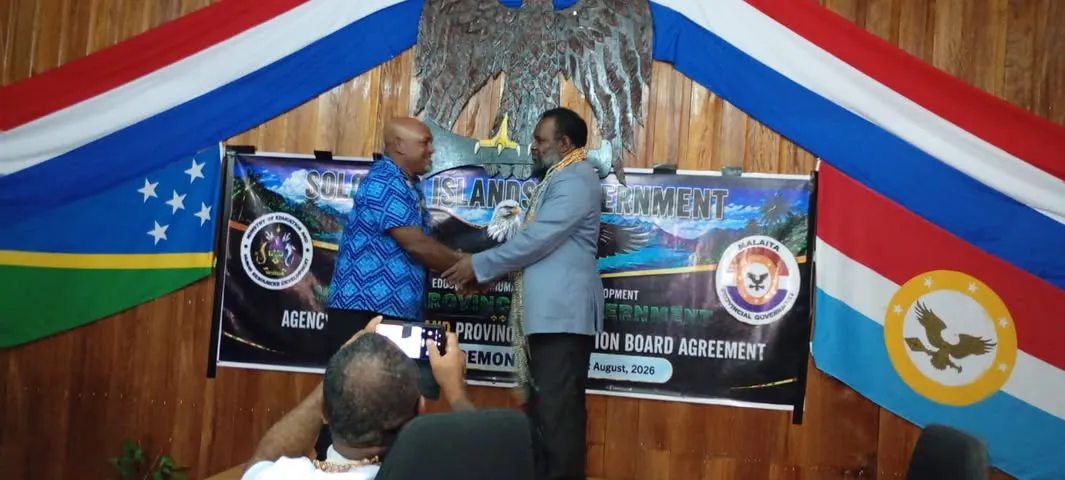
Premier of Malaita Province, Elijah Asilau’a, made the remarks during the signing ceremony of the Agency Agreement and Provincial Education Board Agreement between the Ministry of Education and Human Resource Development (MEHRD) and the Malaita Provincial Government on Friday, August 21.
Premier Asilau’a said the agreements would provide Malaita with an important framework for cooperation, administration, funding, compliance, technical assistance and advisory support from the Ministry.
“On behalf of the people of Malaita, I acknowledge and commend the Solomon Islands GREAT Government for its continued commitment to strengthening education and human resource development as a foundation for national transformation,” he said.
“Education remains one of the most powerful instruments for empowering our people, creating opportunities and preparing our young generation to participate meaningfully in the social and economic development of our nation,” he added.
He said the agreements would further strengthen the administration of the Malaita Education Provider Office and the Malaita Education Coordination Office, while promoting greater coordination among the government, churches, communities and other education providers.
Meanwhile, Minister of Education and Human Resource Development, Stephen Kumi, assured the Malaita Provincial Government and education partners that the Ministry would continue to work closely with the province during the transition.
“MEHRD remains committed to supporting Malaita through this transition. Through the Agency Agreement, the Ministry will provide ongoing technical and operational support to the Malaita Education Provider Office, including strengthening capacity in school operations and teacher management,” he said.
The signing marks an important step towards strengthening provincial participation in education administration and improving coordination between the national and provincial governments.
For feedback, contact: rodrickdesuri50@gmail.com
Editor: irwin2angiki@gmail.com
Four New Officers to Strengthen
Education Services in Malaita
By SOLOMON LOFANA
Solomon Star, Auki
Four new officers will be recruited to support the Malaita Provincial Education Provider Office, which is now under the Malaita Provincial Government.
Minister for Education and Human Resources Development (MEHRD) Stephen Kumi announced the new positions during the signing of an Education Agency Agreement between MEHRD and the Malaita Provincial Government in Auki on Friday, August 21.
Mr Kumi said the additional positions would strengthen the province’s education services and would be supported by the government and its development partners.
“In fact, I am pleased to announce that, upon request, an additional four positions will be allocated to Malaita Education Providers by next year, 2027, to provide the workforce needed to strengthen provincial education services,” Mr Kumi said.
He also announced plans to construct a new office for the Provincial Education Coordination Office (PECO) in Malaita.
The new office will accommodate the various education coordination functions, formerly known as Education Authorities.
Mr Kumi said the initiative would empower education providers to take on their responsibilities with greater confidence, knowing that MEHRD stands firmly behind Malaita Province.
The additional officers and new office are expected to further strengthen the delivery and coordination of education services across the province.
End///////with pix
Photo caption:
Former Malaita Chief Education Officer Andy Siarani left handed over shell money to the Malaita Provincial Premier, who will serve as the new Education Provider Officer for Malaita Province. Photo: Solomon Lofana
BY JOSES SAREN
SAINT Nicholas Anglican College has marked its 40th anniversary with a dawn parade, thanksgiving service, speeches, cultural performances and a symbolic release of 40 balloons at the school ground in Honiara yesterday.
Hundreds of students, teachers, alumni and supporters gathered at the secondary school square yesterday under the anniversary theme, “Honouring the Past, Inspiring the Future.”
The celebrations began at 6:45am at the Solomon Islands National University Kukum Campus field, where students, teachers and alumni assembled before parading to the college behind the Royal Solomon Islands Police Force.
The procession arrived shortly after 7:45am, marking the beginning of the official anniversary programme.
Master of ceremonies Cornelius Titilli opened the programme, followed by a prayer led by the Dean of St Barnabas Cathedral, Very Rev. Fr Wilfred Kekea.
Guests and dignitaries sat on stage under a banner marking the school’s 40th anniversary, themed “Honouring the Past, Inspiring the Future,” yesterday. Photo: Joses Saren.
The national anthem and school song were then performed before Board Chairman Henry Kuper delivered a historical address reflecting on the founding and development of the college.
Guest of honour Right Reverend. Bishop Othniel Gamutu delivered the keynote address, followed by remarks from Alumni Representative Stephanie Titili and Principal Jon Patteson.
Long Service Awards were presented to Canon Christina Vunagi, Joy Fanasi and Nelson Vike in recognition of their contribution to the college. The awards for Vunagi and Vike were received on their behalf as they were unable to attend.
Students gather under a marquee during St Nicholas Anglican College’s 40th anniversary celebration at the school ground, on Friday. Photo: Joses Saren.
Principal Jon Patteson was also honoured during the anniversary programme.
At 10:30am, 40 helium balloons were released by Fr Peter Meta, Caroline Kelimana, Jon Patteson, Serah Taniro and Bishop Gamutu.
The balloon release symbolised the college “rising higher” in unity as it celebrated four decades of education and service.
The anniversary cake was subsequently cut by Desmond Waita, Francis Wate, Salome Vuthia, Stephanie Titili and the Alumni Chairman.
The celebration continued into the afternoon with cultural performances presented by student groups representing different provinces.
The programme concluded with the hymn “To God Be The Glory”, followed by a closing prayer from Deacon Manoah Suka.
The 40th anniversary brought together generations of the Saint Nicholas Anglican College community to reflect on its history while looking ahead to its future.
For feedback, contact: josessaren@gmail.com
Editor: irwin2angiki@gmail.com