Serbia and Solomon Islands deepen ties through cooperation in energy, education, digitalisation, tourism and sports. Solomon Islands and Serbia are moving to translate their growing bilateral relationship into practical development outcomes, with cooperation being explored in renewable energy, education, digitalisation, sports, tourism and community development. This was the focus of discussions between Minister for National [...]
The post SERBIA LOOK TO TURN BILATERAL TIES WITH SOLOMON ISLANDS INTO PRACTICAL DEVELOPMENT GAINS appeared first on Tavuli News (Solomon Islands) .
BY DOUGLAS VAHIA
The Solomon Islands Electoral Commission (SIEC) is strengthening its electoral capacity and institutional development through a three-day Knowledge Exchange Program (KEP) with the Australian Electoral Commission (AEC) in Canberra, Australia.
According to the SIEC, the program which began on Tuesday at the AEC’s National Office, brings together the SIEC delegation and Australian electoral officials to exchange experiences and explore practical approaches to improve election management and workforce development.
The opening sessions focused on SIEC’s current workforce planning and its management of Temporary Election Workers (TEWs).
The SIEC delegation outlined its existing approaches, providing the basis for discussions on electoral reforms, operational training and staff development.
A key area of the exchange has been the AEC’s “Learn, Practice, Apply” framework, which is used in developing its national trainer pool and leadership development programs.
On Wednesday, discussions moved to the operational aspects of election delivery, including the recruitment and on boarding of Temporary Election Workers, training and assessment methods, and governance processes.
The delegation also examined the AEC’s e-learning systems and how technology, accessibility and connectivity are being incorporated into staff training.
The remaining sessions of the program will focus on broader workforce development models and leadership pathways, as well as strategic electoral issues relevant to Solomon Islands.
These include out-of-country voting and constituency voting areas, which are becoming increasingly important as Solomon Islands considers further electoral reforms.
Chief Electoral Officer Jasper Highwood Anisi described the knowledge exchange as “timely and practical,” highlighting its relevance to SIEC’s preparations for the 2027 Biometric Voter Registration and the 2028 Joint Elections.
He said the program provides an opportunity for SIEC to learn directly from the AEC’s experience and consider how relevant practices can be adapted to the Solomon Islands context.
“The Knowledge Exchange Program gives us a chance to learn directly from the AEC’s experience and adapt those lessons to our own context,” Mr Anisi said.
The program is scheduled to conclude on Friday with a reflection session, discussions on next steps and a forward-looking review of SIEC’s electoral reform agenda.
The engagement between the two electoral bodies provides an opportunity for SIEC to strengthen its institutional knowledge and draw on Australia’s experience in election administration as Solomon Islands prepares for major electoral activities in the coming years.
Photo credit: SIEC
For feedback, contact: diivee56@gmail.com
Editor: irwin3angiki@gmail.com
BY BEN BILUA
Jejevo
THE partnership between the United Church of Solomon Islands (UCSI) and the Anglican Church of Melanesia (ACOM) continues to grow stronger, particularly through the Diocese of Ysabel.
UCSI Bishop Reverend Hillary Bero highlighted the growing relationship between the two churches while attending the 18th Synod of the Diocese of Ysabel at Jejevo this week.
Speaking to Island Sun , Bishop Bero said the partnership between UCSI and ACOM had been built on a common understanding and a shared desire to strengthen church life in communities.
He said the participation of UCSI clergy in the synod is another way of bringing the two churches closer, particularly in pastoral work.
“A portion of the Diocese of Ysabel is in Western Province, but it is dominated by the United Church,” Bero said.
He said ACOM, through the Diocese of Ysabel, is the church with which UCSI had developed the closest working relationship in the Western Province.
Bero explained that the partnership had also opened opportunities for UCSI clergy and students to undertake theological studies at the ACOM’s Kohimarama campus.
He said UCSI currently offers diploma-level theological studies, while students who wish to pursue further theological education have the opportunity to continue their studies at Kohimarama.
“ACOM also sponsors some of our UCSI students to study at Kohimarama,” Bero said.
He said the two churches continue to share human resources, training opportunities and other activities as part of their partnership.
Bero acknowledged that UCSI had a much smaller number of members compared to ACOM, making cooperation and partnership important in strengthening its ministry.
He said the existing relationship between UCSI and ACOM through the Diocese of Ysabel could serve as an example for other churches.
“It is my wish for other sister churches to have a partnership like the one shared by ACOM through DOY,” Bero said.
He encourages churches to understand and respect each other while working together to advance their common mission.
“Each church should understand each other and move together to improve the mission of God on earth,” Bero said.
For feedback, contact: maetuana777@gmail.com
Editor: irwin3angiki@gmail.com
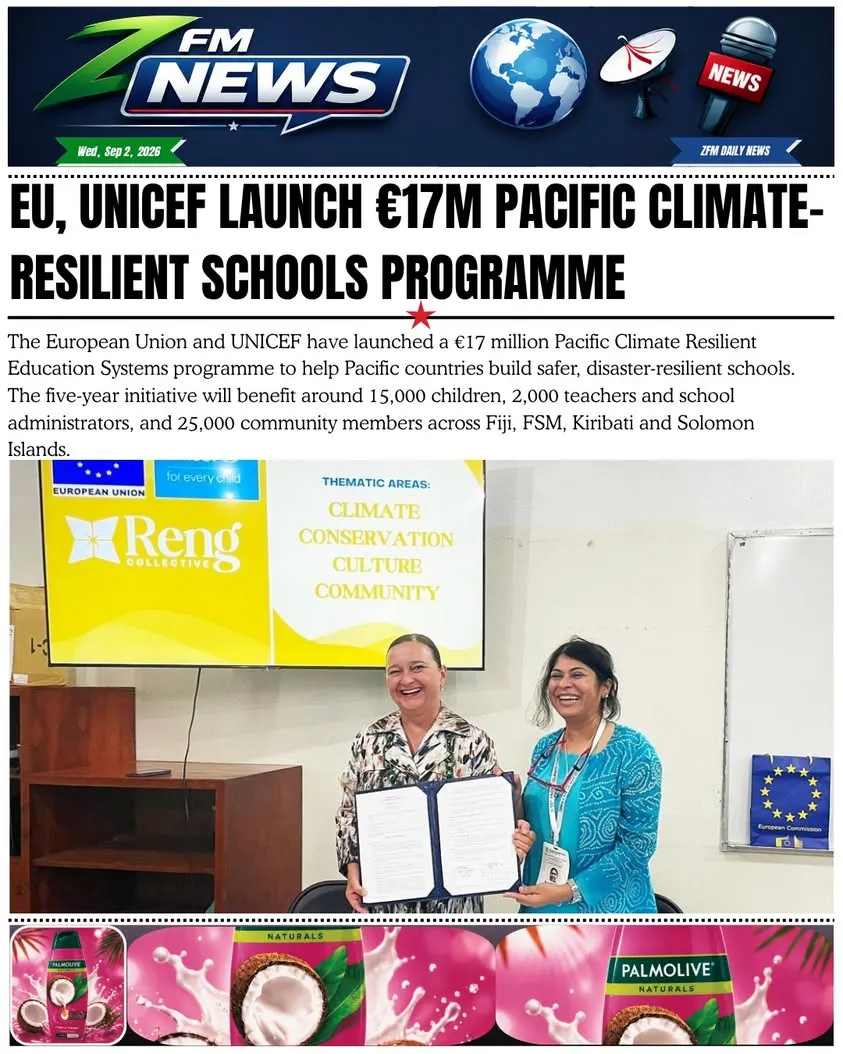
EU and UNICEF Launch €17 Million Pacific Climate-Resilient Education Programme
KOROR, PALAU – 2 September 2026: The European Union and UNICEF have launched a €17 million programme aimed at helping Pacific countries build safer and more climate-resilient schools.
The Pacific Climate Resilient Education Systems (Pacific CRES) programme was signed and launched during a side event of the 55th Pacific Islands Forum Leaders Meeting in Palau.
The five-year initiative will support Fiji, the Federated States of Micronesia, Kiribati and Solomon Islands in strengthening school infrastructure and preparing education systems for climate-related disasters.
Across the Pacific, cyclones, floods and rising sea levels continue to damage classrooms, water systems and other school facilities, particularly in remote communities.
The programme will upgrade existing school infrastructure, strengthen maintenance systems and introduce practical measures to help schools remain operational during and after disasters.
Planned improvements include climate-resilient water and sanitation facilities, renewable energy systems and improved connectivity.
The initiative will also help governments plan and budget for the long-term maintenance of school facilities, reducing the cycle of repeated damage and reconstruction following disasters.
UNICEF Pacific Deputy Representative Roshni Basu said the programme would focus on long-term solutions to protect children's education from growing climate and disaster risks.
Over the next five years, Pacific CRES is expected to directly benefit around 15,000 children through improved school facilities.
It will also provide training for approximately 2,000 teachers and school administrators on disaster preparedness and school resilience, while engaging around 25,000 community members in disaster risk reduction and school maintenance activities.
The programme will be implemented by Ministries of Education in partnership with UNICEF, National Disaster Management Offices, climate change authorities and regional organisations across the four participating countries.
[ENDS]///
By Lesley Foinagwa
Foubaba Community High School in West Kwaio, Malaita Province has marked a major milestone with the official handover of its new School Assembly Hall, delivered through the Australia–Solomon Islands Partnership and facilitated by the West Kwaio Constituency.
The ceremony on Monday, 31 August 2026 brought together community leaders, parents, church representatives, teachers, students and the wider Foubaba community, highlighting strong local ownership and collective pride in the new development.
Second Secretary of DFAT, Bridgette Cottrill , attended on behalf of the Australian Government and congratulated the community, emphasising that the project reflected the power of working together to strengthen education services. “We are together to build our school, Foubaba. Congratulations to everyone,” she said.
The new Assembly Hall will serve as a central space for school assemblies, learning activities, community gatherings and important events providing a safer, more functional environment for students and teachers.
School Principal Dudley Su’akeu expressed deep appreciation to the Australian Government, the Solomon Islands Government and the West Kwaio Constituency for enabling the project. He said the handover marked a significant achievement for the school and a long‐term investment in the wellbeing of students and the community.
The project is part of the ongoing Australia–Solomon Islands partnership supporting community development and improved education infrastructure across Malaita Province. For Foubaba Community High School, the completion of the Assembly Hall represents progress, unity and a stronger future for generations of learners.
BY BEN BILUA
Jejevo
THE proposed establishment of a Western Region has emerged as one of the key issues before the 18th Synod of the Diocese of Ysabel (DOY).
The proposal is among 10 motions tabled for debate during day four of the Synod currently underway in Jejevo.
The proposed Western Region is intended to address administrative and logistical challenges faced by the Diocese in serving its communities in the Western and Choiseul provinces.
If adopted, the proposal would introduce a new administrative structure aimed at improving the Diocese’s reach and delivery of ministry services to communities in the two provinces.
Other motions before the Synod include a proposal for St Peter at Noro Base to become a stand-alone parish and a call for St Luke Gizo Parish to develop DOY land.
Members will also debate issues relating to gambling and lottery in the Diocese, as well as a motion calling for holiness and faithful leadership among church leaders.
Another proposal seeks to establish a partnership between DOY and Chinese investors in retail business, while a separate motion calls for land to be allocated to the Diocese by the Isabel Provincial Government.
The Synod will also consider the establishment of Jejevo Community High School under the Anglican Church of Melanesia Education Authority.
Other motions address the resettlement of clergy, officiating church services where liquor is consumed, and a proposal for parishes to raise funds towards the Cathedral.
The 10 motions will be presented and debated by Synod members before being put to a vote.
Motions receiving the support of members will be adopted and incorporated into the final resolutions of the 18th Synod.
The outcomes are expected to shape the Diocese’s administration, ministry and development priorities in the years ahead.
For feedback, contact: maetuana777@gmail.com
Editor: irwin2angiki@gmail.com
BY BEN BILUA
Jejevo
THE Diocese of Ysabel (DOY) 18th Synod has passed five motions following deliberations during its third-day session yesterday.
The motions were presented on the floor of the Synod, debated by members and subsequently put to a vote before being vetted and approved by Synod Chairperson Bishop Christopher Hope Fihu.
The five motions passed are the Strategic Plan of the Diocese of Ysabel, Strategic Plan Draft Committee 2026, establishment of a Reconciliation Office, re-appointment of the Diocesan Cathedral Committee 2026, and recruitment of an Education Secretary.
The motions will now form part of the Synod resolutions and will be further deliberated and incorporated into the Diocese’s three-year strategic plan.
Bishop Fihu acknowledged the movers of the motions and Synod members who contributed to the discussions and debates before the motions were passed.
He encouraged clergy and Synod members to critically discuss issues affecting the Church, saying constructive debate is important in identifying practical solutions.
Bishop Fihu said open and critical discussions would enable the Diocese to address its challenges and strengthen its ministry and programmes.
The passage of the five motions is expected to provide direction for several areas of the Diocese’s work as it develops and implements its priorities over the next three years.
Other motions will be tabled today as the Synod continues.
For feedback, contact: maetuana777@gmail.com
Editor: irwin2angiki@gmail.com
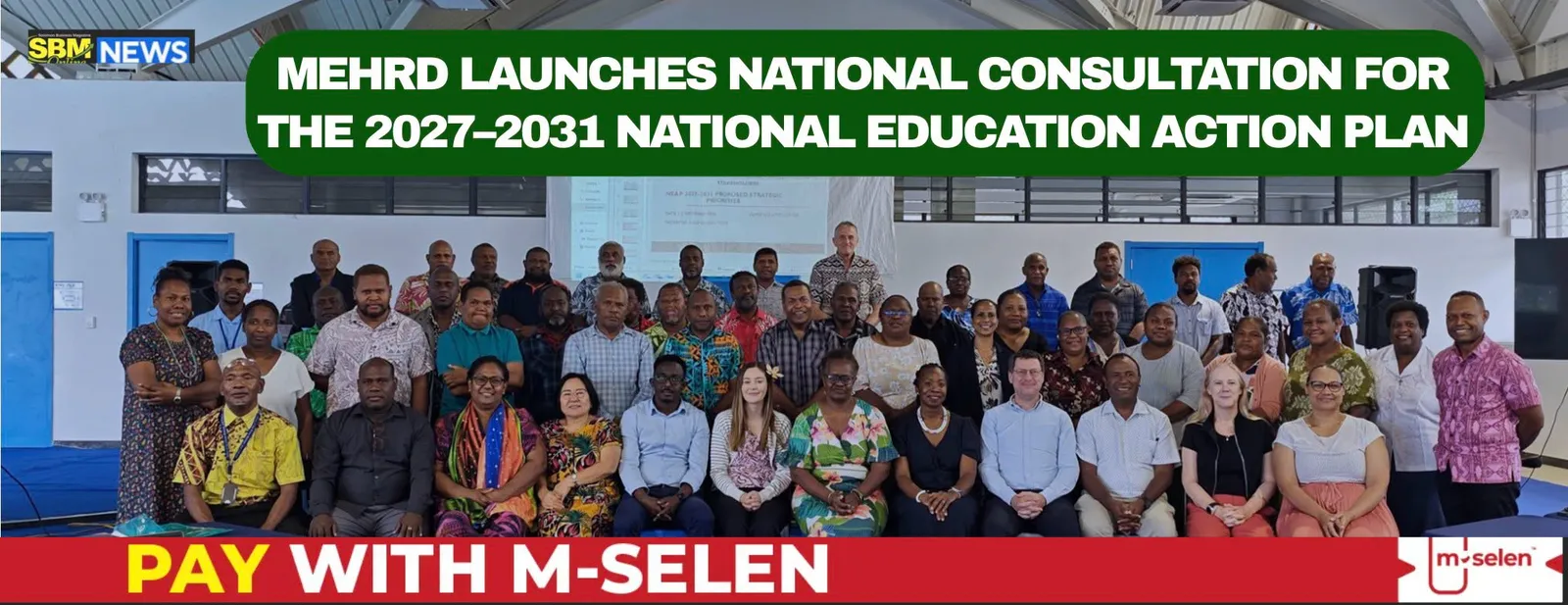
MEHRD LAUNCHES NATIONAL CONSULTATION FOR THE 2027–2031 NATIONAL EDUCATION ACTION PLAN
The Ministry of Education and Human Resources Development (MEHRD) today officially launched the national consultation for the development of the National Education Action Plan (NEAP) 2027–2031 at the National Aquatic Centre in Honiara.
The two-day consultation, held from 1–2 September 2026, brings together provincial governments, education providers, school leaders, teachers, student representatives, youth and women, development partners, faith-based organisations, non-government organisations, civil society organisations, MEHRD officials and representatives of the Solomon Islands Government.
The NEAP 2027–2031 will serve as the education sector’s principal five-year implementation plan. It is grounded in a planning framework that links Sustainable Development Goal 4, the Pacific Regional Education Framework, the Solomon Islands National Development Strategy, the Education Strategic Framework 2015–2030, successive National Education Action Plans and MEHRD annual work plans.
Delivering the official opening statement, MEHRD Supervising Permanent Secretary Mrs Linda Wate said the new NEAP must not be viewed simply as a Ministry document, but as a national education plan belonging to all Solomon Islanders.
She said the plan must reflect the experiences, aspirations, challenges and priorities of the provinces, schools, teachers, learners, families and communities. “We cannot shape the future of education from Honiara alone,” Mrs Wate said.
Mrs Wate encouraged participants to examine honestly the achievements and challenges of the current NEAP 2022–2026 and determine what the education sector should continue, stop or begin doing differently. She stressed that learners must remain at the centre of every discussion and decision.
She also emphasised that inclusion must meaningfully address the needs of children in remote and rural communities, learners with disabilities and additional learning needs, girls and boys, young people at risk of dropping out, and others who experience barriers to quality education.
Provincial ownership, she said, would be essential because education challenges and service-delivery conditions vary significantly between urban centres and remote island communities. The new plan must therefore provide clear national direction while remaining responsive to provincial and local realities.
Mrs Wate called for a practical plan that clearly identifies intended outcomes, responsibilities, resources, timelines and measures of progress. She also urged government, development partners and communities to work towards one national education agenda, one set of priorities and coordinated implementation.
Mr Benjamin Grubb, Head of Office, UNICEF Solomon Islands, addressed the launch and reaffirmed UNICEF’s support for an inclusive, equitable and evidence-informed national education plan centred on the needs, rights and wellbeing of every child.
Ms Sammy O’Hara, Second Secretary, New Zealand High Commission, also addressed participants and reaffirmed New Zealand’s continuing partnership with the Solomon Islands Government and its support for national education priorities.
Consultation to validate and prioritise strategies
During the consultation, participants will consider a consolidated analysis of the education sector, including achievements, continuing challenges and recommendations for improvement. They will review proposed strategic priorities using a “Start–Stop–Continue” approach to identify effective strategies that should continue, approaches that should stop or be revised, missing interventions and priority actions for implementation from 2027.
Participants will also hear the perspectives of students and parents and work towards consensus on the key recommendations to be incorporated into the final NEAP 2027–2031.
The consultation represents an important opportunity for education stakeholders to collectively shape a practical, achievable and inclusive plan that improves learning and supports the wellbeing of every learner in Solomon Islands.
The workshop will conclude on Wednesday, 2 September 2026.
Chottu takes Solomon Islands voice to Melbourne sports roundtable
BY RICHARD MENANOPO
SOLOMON Islands Chess Federation (SICF) president Simon Chottu is in Melbourne, Australia, taking part in a regional roundtable focused on innovation, digital transformation and sustainable development in sport.
The two-day programme, organised by WhiteBIT Australia, brings together chess leaders and representatives from across Oceania, including Australia, Papua New Guinea, Fiji, Vanuatu, Kiribati and Solomon Islands.
The discussions are looking at how technology and innovation can strengthen sporting organisations, improve access to opportunities across the Pacific and develop more sustainable funding models.
For SICF, the programme also provides an opportunity to explore ways of expanding chess in schools and creating more opportunities for young players in Solomon Islands.
SICF President Simon Chottu joins fellow Oceania sports representatives during the Melbourne Roundtable programme.
Chottu said the gathering was important for smaller Pacific sporting federations to build partnerships and ensure that their voices are included in discussions about the future of sport.
“For Solomon Islands, this is about creating opportunities. Technology can help overcome the challenges of distance and limited resources, while partnerships can help us provide more competitions, training and development opportunities for our young people,” he said.
As part of the programme, Chottu will also visit a school chess tournament at Camberwell Boys Grammar School.
The visit will allow him to observe the development of school chess in Australia and engage with organisers and participants.
Participants engage in discussions during the Melbourne Roundtable on innovation and sustainable development in sport.
SICF said chess in schools remains an important part of its long-term development programme and hopes the Melbourne visit will provide lessons that can support the expansion of the sport among schools and young people in Solomon Islands.
The visit is also expected to strengthen relationships among Oceania chess federations and open discussions on possible cooperation in youth development, technology, sponsorship, competitions and regional chess programmes.
SICF said the Melbourne engagement forms part of its broader efforts to grow chess and create more opportunities for Solomon Islands players.
For feedback, contact: mnorichard4@gmail.com
Editor: irwin2angiki@gmail.com
BY JOSES SAREN
Shortland Islands Constituency has received a $1.5 million China-funded fishing project under the Rural Sustainable Development Programme (RSDP).
The package, delivered in partnership with the Ministry of Rural Development (MRD), includes 16 fibreglass open utility boats and 16 60-horsepower outboard motors, which will support transportation, livelihoods and economic activities in rural communities across the constituency, the Ministry said.
According to the Ministry, the handover ceremony took place at Point Cruz Wharf on 20th August, before the goods were loaded onto a waiting vessel bound for the constituency.
Speaking on behalf of the Constituency Office and the Shortland Communities, Constituency Development Committee representative Caroline Laore thanked the PRC for the assistance, describing a partnership she says aligns directly with the constituency’s four-year development programme.
“It is a great honour to receive this generous gift, which reflects a profound recognition of the needs and aspirations of our people,” she said.
Laore, representing the Women of Shortland Islands, said the shared fishing heritage between the two countries makes the gift especially meaningful. “As you all know, we come from fishing backgrounds, in Solomon Islands as in China, and what you have done is ensure that our people will receive a direct benefit by improving the capacity of their fishing techniques,” she said, adding that fishermen will now be able to travel further out to sea, with benefits rippling through the wider village economy.
She pointed out that the boats come fitted with tyres at the bow to prevent cracking against rocks, paired with reliable engines that will improve both food security and safety at sea.
“This assistance will increase household incomes, improve food security, and uplift the dignity of the hard-working men and women who depend on the ocean for their livelihood,” Laore said.
For her, the gesture speaks to something beyond the equipment itself. “It shows that our friendship is not abstract, but practical, rooted in meeting real needs and improving lives,” she said, adding that the income earned would help families pay school fees, giving the next generation the same chance at higher education that many now working in Honiara have had.
Laore thanked the governments and people of both China and Solomon Islands, and acknowledged the constituency’s Member of Parliament for his continued support of rural development initiatives. “May this collaboration continue to flourish, bringing prosperity to our communities and reinforcing the enduring friendship between Solomon Islands and the People’s Republic of China,” she said.
Chinese Embassy Counsellor Li Qinghua, meanwhile, congratulated the Shortland Islands Constituency office and beneficiary communities on receiving the project.
She framed the assistance within China’s broader philosophy on global development. “The over 190 countries and regions of the world are not on separate boats. We are on one huge boat. If one room of the boat gets water, the whole boat tips and sinks,” Li said, describing a “shared future” in which no one should be left behind.
For her, the support carries a meaning that goes beyond the boats themselves. “It is a tool for fishermen to generate income, hope for schoolchildren to access education, and a lifeline for the sick in medical emergencies,” Li said, noting that the gifts reflect “the deep feelings and affection of the Chinese government and people toward the government and people of Solomon Islands.”
She explained that with 85 percent of Solomon Islands’ population living in rural areas, channelling support through RSDP was a deliberate choice. “If you want a tree to grow healthy, strong and bear good fruit, you should take care of the roots,” Li said, likening rural development to nurturing those roots to give “more productivity and momentum to growth.”
Li closed by wishing the RSDP programme success in Shortland Islands, and voiced hope that Solomon Islands–China relations would continue to grow from strength to strength.
MRD said the RSDP is a partnership programme between the PRC and the Solomon Islands Government through the Ministry, noting that China has backed the proposal-based initiative since 2023, jointly implemented by MRD and the Chinese Embassy.
The programme aligns with China’s Global Development Initiative, including the Belt and Road Initiative, and supports Solomon Islands’ National Development Strategy (NDS) 2016–2035, according to MRD. It targets rural and semi-urban communities, with a focus on strengthening social and economic infrastructure, promoting income-generating activities, and addressing food security and climate resilience.
MRD said other constituencies have received similar support under RSDP phase 2 funded projects.
For feedback, contact: josessaren@gmail.com
Editor: irwin2angiki@gmail.com
BY DOUGLAS VAHIA
Two new books exploring Christian faith, spiritual experience and the search for a deeper relationship with Jesus Christ were officially launched at Qaleli Zelepade, Kindu, Munda, on Sunday, August 23.
According to a press release by J. D. Tausinga, the books Souls in the Desert of Hopelessness and Notebook to Heaven were officially launched by the author and publisher, J. D. Tausinga, Head of the Christian Fellowship Church (CFC), during a combined gathering of the United Church and the Christian Fellowship Church.
The homily and dedication for the books were conducted by United Church ministers Reverend Hillary Bero and Reverend Wilson Agiri.
The launch brought together members and supporters of both church communities for a time of fellowship, prayer and celebration.
The two publications share a central message focused on the Christian journey as a search for Jesus Christ and a deeper experience of His presence through the Holy Spirit.
Souls in the Desert of Hopelessness challenges Christian teachers, preachers, pastors, scholars and spiritual leaders to go beyond simply imparting knowledge about Jesus.
The book encourages Christian leaders to guide people towards a personal encounter and experience with Christ.
It poses a central question to readers: “Are we teaching about Jesus, or are we leading people to experience Him?”
Meanwhile, Notebook to Heaven documents the life and spiritual journey of the late Silas Eto, who was known spiritually as Holy Mama, and his search to know Jesus.
The book explores Eto’s spiritual and theological reflections while preserving what the author describes as an important part of Christian history and spiritual experience in Solomon Islands.
Together, the two books encourage readers to move from knowledge to encounter, and from encounter to transformation, with Jesus at the centre of the Christian journey.
Tausinga said the publications were written to strengthen faith, preserve spiritual history and encourage people to seek Jesus more deeply.
The books are also available to readers outside Solomon Islands through major international online bookstore platforms, allowing their messages and the spiritual history they preserve to reach an international audience.
Royalties from the two books, together with royalties from Tausinga’s other published works, will support the J. D. Tausinga Charity Foundation Trust.
The Trust is currently undergoing incorporation under the Charitable Trusts Act of Solomon Islands and is committed to serving humanity through education, leadership and compassion.
For feedback, contact: diivee56@gmail.com
Editor: irwin2angiki@gmail.com
作者:道格拉斯·瓦希亚
两本探讨基督教信仰、灵性体验以及与耶稣基督建立更深关系的新书于8月23日星期日在蒙达的Qaleli Zelepade正式发布。
根据J. D. Tausinga的新闻稿,这两本书《绝望沙漠中的灵魂》(Souls in the Desert of Hopelessness)和《通往天堂的笔记本》(Notebook to Heaven)由作者兼出版人J. D. Tausinga(基督教联谊教会(CFC)负责人)在联合教会和基督教联谊教会的联合聚会上正式发布。
联合教会的牧师希拉里·贝罗(Reverend Hillary Bero)和威尔逊·阿吉里(Reverend Wilson Agiri)为这两本书进行了讲道和献书仪式。
此次发布会将两个教会社区的成员和支持者聚集在一起,进行联谊、祷告和庆祝。
这两本书传达了一个核心信息,聚焦于基督教旅程作为对耶稣基督的追寻,以及通过圣灵体验到更深的存在。
《绝望沙漠中的灵魂》挑战基督教教师、传道者、牧师、学者和灵性领袖超越单纯传授关于耶稣的知识。
该书鼓励基督教领袖引导人们与基督进行个人的相遇和体验。
它向读者提出一个核心问题:“我们是在教导耶稣,还是在引导人们去体验他?”
与此同时,《通往天堂的笔记本》记录了已故的西拉斯·埃托(Silas Eto)的生活和灵性旅程,他在灵性上被称为“圣母”(Holy Mama),以及他对认识耶稣的追寻。
该书探讨了埃托的灵性和神学反思,同时保留了作者所描述的所罗门群岛基督教历史和灵性体验的重要部分。
这两本书共同鼓励读者从知识走向相遇,从相遇走向转变,以耶稣为基督教旅程的中心。
Tausinga表示,这些出版物旨在增强信仰、保留灵性历史,并鼓励人们更深入地寻求耶稣。
这些书籍也通过主要国际在线书店平台向所罗门群岛以外的读者提供,使其信息和所保留的灵性历史能够传达给国际观众。
这两本书的版税,以及Tausinga其他出版作品的版税,将支持J. D. Tausinga慈善基金会信托。
该信托目前正在根据所罗门群岛的慈善信托法进行注册,致力于通过教育、领导力和同情心服务人类。
反馈请联系:diivee56@gmail.com
编辑:irwin2angiki@gmail.com
BY NED GAGAHE
BUSINESSES have been urged to start preparing now for the introduction of Value Added Tax (VAT), with Minister of Finance and Treasury Gordon Darcy Lilo warning that preparation cannot be left until implementation day.
Lilo made the call this morning while opening the formal Tax Policy Work Programme consultation at Heritage Park Hotel in Honiara.
Addressing representatives from the private sector, business community, non-governmental organisations (NGOs), accounting profession and other stakeholders, the Minister said businesses would need sufficient time to understand and meet their new obligations under the VAT system.
The consultation brought together representatives from the private sector, business community, NGOs, accounting profession and other stakeholders to discuss the Government’s tax policy this morning at Heritage Park Hotel. Photo Ned Gagahe.
He said VAT would bring significant changes to the country’s tax system and businesses must begin preparing well ahead of implementation.
“Businesses will need to prepare for requirements relating to VAT registration, invoicing, record keeping, the charging and reporting of VAT, and the claiming of legitimate input tax credits,” Lilo said.
He stressed that businesses should not wait until the last minute before taking action.
“This preparation cannot be left until the last minute,” he warned.
Lilo said businesses would need time to make changes to their accounting and invoicing systems, train their staff and seek answers to questions about their VAT responsibilities.
He said the Government was committed to starting the education and communication process early to help businesses understand what would be required of them.
“There will be further information, guidance, workshops and stakeholder engagement as we move towards implementation,” he said.
Lilo encouraged businesses and other stakeholders to actively participate in the Government’s education and consultation activities and to begin their own preparations now.
He said successful VAT implementation would require cooperation between Government agencies, businesses, professional advisers and the wider community.
“VAT will require preparation, and preparation is a shared responsibility,” Lilo said.
The Minister also clarified that the Government had already made its policy decision to introduce VAT, with the fundamental design of the regime settled.
He said the current focus was therefore on education, preparedness and implementation rather than reopening the policy decision on whether Solomon Islands should introduce VAT.
The Inland Revenue Division will be responsible for preparing the administration of the VAT system, including training staff, developing systems and procedures, issuing guidance and registering taxpayers.
Lilo said the Economic Development Division would also assess the broader economic implications of the reform and ensure VAT implementation supports the Government’s economic and fiscal objectives.
For feedback, contact: nedgagahe@gmail.com
Editor: irwin2angiki@gmail.com
BY NED GAGAHE
THE Government has made its decision to introduce Value Added Tax (VAT), and the policy decision will not be reopened, Minister of Finance and Treasury Gordon Darcy Lilo has declared.
Lilo made the declaration today morning while opening the formal Tax Policy Work Programme consultation at Heritage Park Hotel in Honiara.
The tax policy work programme consultation yesterday. Photo Ned Gagahe.
The consultation brought together representatives from the private sector, business community, non-governmental organisations (NGOs), accounting profession and other stakeholders to discuss the Government’s tax policy programme.
However, Lilo made it clear that the consultation was not an opportunity to debate whether Solomon Islands should introduce VAT.
“The Government has made its policy decision on VAT. The fundamental design of the VAT regime has been settled,” he said.
Lilo said the focus must now shift to understanding the VAT Bill and ensuring businesses and taxpayers are properly prepared for its implementation.
He said VAT would represent a significant change to the country’s tax system and businesses would need to prepare for new requirements covering VAT registration, invoicing, record keeping, charging and reporting of VAT, as well as claiming legitimate input tax credits.
“This preparation cannot be left until the last minute,” Lilo warned.
He said businesses must be given enough time to make necessary changes to their accounting and invoicing systems, train staff and seek clarification on their obligations.
Lilo said the Government was committed to starting the education and communication process early, with further information, guidance, workshops and stakeholder engagement to be provided as implementation approaches.
He also stressed that VAT was not simply an Inland Revenue reform but a whole-of-Government reform requiring cooperation between Government agencies, businesses, professional advisers and the wider community.
The Minister said the Inland Revenue Division would be responsible for preparing the administration of the VAT system, including staff training, systems and procedures, taxpayer registration and issuing guidance.
The Economic Development Division would also play a role in assessing the wider economic implications of the reform and ensuring VAT implementation supports the Government’s economic and fiscal objectives.
Lilo said the wider Tax Policy Work Programme contained reforms at different stages, with some still requiring further policy analysis and consultation.
However, where Government had already made a policy decision, he said the focus should now be on implementation, preparedness and compliance.
He said the GREAT Government’s broader objective was to build a tax system that was more transparent, predictable and understandable while strengthening domestic revenue mobilisation and improving compliance.
“Our objective is not simply to introduce new taxes,” Lilo said.
“Our objective is to build a stronger, fairer and more sustainable tax system that supports domestic revenue mobilisation, improves compliance and provides Government with the resources needed to deliver essential services and pursue our national development priorities.”
He said VAT was an important part of that reform and called on Government, businesses and taxpayers to work together to ensure a successful transition.
For feedback, contact: nedgagahe@gmail.com
Editor: irwin2angiki@gmail.com
BY BEN BILUA
In Jejevo
THE 18th Synod of the Diocese of Ysabel (DOY) has entered its third day with a number of reports, motions, resolutions and proposed changes to the administration and structure of the diocese.
Day three began with a Holy Eucharist led by Reverend Hudson Norman, followed by breakfast before delegates proceeded to the main synod session.
The session is being presided over by the Chair of the 18th Synod, Bishop Christopher Hope Fihu.
Also present during the synod session is a legal team from Whitlam K Togamae Lawyers providing legal advice.
The first business includes confirmation of the minutes from day two, followed by a call for questions, motions, reports, resolutions and bills.
A number of reports are scheduled to be presented during the session.
These include reports from the Senior Priest of Zamako, Senior Priest of the Gaoma Region, Senior Priest of Lawela and Senior Priest of Tuvano.
The Mission Secretary and Evangelist Coordinator are also expected to present their respective reports.
Reports from the Sunday School and Youth and the Mother Union are also part of the day’s agenda.
Among the key matters before the Synod is Motion One, concerning the Strategic Plan of the Diocese of Ysabel.
The Synod is also expected to consider the work of the Strategic Plan Draft Committee established for 2026.
Other matters on the agenda include the proposed establishment of a Reconciliation Office and the re-appointment of the Diocesan Cathedral Working Committee for 2026.
The Synod will also consider the recruitment of an Education Secretary as part of strengthening the diocese’s administrative and education work.
A proposal to establish a Western Region within the Diocese of Ysabel is also before the Synod.
Another significant proposal is for St Peter Church at Noro to become a standalone parish.
The proposals and reports are expected to provide delegates with an opportunity to assess the current work of the diocese and consider priorities for its future ministry.
The 18th Synod brings together clergy, church leaders and representatives to deliberate on matters affecting the Diocese of Ysabel and its ministry.
The deliberations continue as the Synod works through its agenda and considers the proposed motions, reports and resolutions.
BY DOUGLAS VAHIA
Solomon Islands and Japan have reaffirmed their longstanding friendship and commitment to strengthening bilateral cooperation across key development and strategic areas.
The commitment was reaffirmed during a bilateral meeting between Minister of Foreign Affairs and External Trade Rick Houenipwela, Minister of National Planning and Development Coordination Peter Kenilorea Jr, and Japan’s State Minister for Foreign Affairs Iwao Horii on the margins of the 55th Pacific Islands Forum Leaders Meeting in Koror, Palau, a statement by the PM Press Secretariat today said.
Mr Houenipwela welcomed Japan’s continued support to Solomon Islands, saying the new Government was focused on re-engaging with traditional partners, with Japan remaining an important longstanding friend and development partner.
The meeting covered cooperation in education, infrastructure, aviation and sports, as well as regional and international issues of mutual interest.
Minister Horii reaffirmed Japan’s commitment to supporting Solomon Islands’ development priorities and said Japanese experts would continue working with relevant Solomon Islands authorities, including through the country’s education task force.
Aviation infrastructure was also highlighted, with Japan expressing its willingness to explore areas of support, including airport infrastructure and terminal development.
Mr Kenilorea stressed the importance of airports to Solomon Islands’ long-term economic development, national connectivity and resilience.
He said the Government was looking at developing airport infrastructure capable of meeting the country’s needs over the next 30 years.
This includes improvements to airport terminals, runways and, where required, aircraft parking facilities.
The two sides also welcomed Japan’s support for football development in Solomon Islands, including the recent donation of footballs to the Solomon Islands Football Federation (SIFF).
Discussions also explored opportunities for Japanese technical expertise to support coaching and further develop football in Solomon Islands.
Regional cooperation was another key focus, including Japan’s engagement with the Pacific through the Pacific Islands Leaders Meeting (PALM) process.
Horii sought Solomon Islands’ support for Japan’s participation in the evolving regional architecture and highlighted Japan’s interest in being recognised as a Strategic Partner.
The two sides also exchanged views on regional peace and security, including developments affecting the Pacific Ocean.
Japan emphasised the importance of maintaining the Pacific as an “Ocean of Peace” and keeping dialogue and communication open among countries.
Kenilorea reaffirmed Solomon Islands’ longstanding friendship with Japan and said the Government looked forward to deeper engagement and practical cooperation.
Both sides agreed to maintain close communication and continue working together to strengthen the Solomon Islands-Japan partnership and deliver tangible development outcomes for the people of Solomon Islands.
BY TONY IROGA
TWO graduates of the Solomon Islands National University (SINU) Faculty of Agriculture, Fisheries and Forestry have departed for China to further their studies at Yangzhou University.
Jimson Maedola and Mark Pitaboe left the country on Thursday, 27 August 2026, after securing Master’s degree scholarships from Yangzhou University.
According to SINU statement today, the scholarships provide an important opportunity for the two graduates to advance their academic qualifications and strengthen their expertise in agriculture.
SINU said their postgraduate studies will also help build advanced knowledge and skills that could contribute to the development of Solomon Islands’ agriculture sector when they return home.
The university congratulated Maedola and Pitaboe on their achievement and wished them every success in their studies in China.
“SINU congratulates Jimson Maedola and Mark Pitaboe on this significant achievement and wishes them every success in their studies in China,” SINU said.
The university said opportunities such as these are important in developing the skills and knowledge needed to support the country’s agricultural sector.
Maedola and Pitaboe are expected to return to Solomon Islands after completing their postgraduate studies and contribute their newly acquired knowledge and expertise to the agriculture sector.
For feedback, contact: tonyiroga8@gmail.com
Editor: irwin2angiki@gmail.com
BY TONY IROGA
For Yandina Community High School (CHS) the journey towards better education is not simply about building classrooms or improving facilities.
Despite the challenges the school is set on creating an environment where students can learn, teachers can teach effectively, parents can take an active role, and the wider community can see the school as a shared investment in the future.
Yandina CHS is the premier school of the Russell Islands, a group of islands in the western end of Central province.
Yandina Community High School compound. Photo credit – Tony Iroga
The increasing number of students attending the school demonstrates the demand for education here, but it also places considerable pressure on the school’s limited infrastructure and resources.
Principal Rockson Mako is leading the secondary sector of the school as it works to address infrastructure needs, improve student discipline and academic performance, strengthen teacher support and rebuild links with parents and communities.
Infrastructure remains a major challenge
Mr Mako said Yandina Community High School needs additional classrooms, staff houses, sanitation facilities and other infrastructure to provide a safer and more suitable environment for its growing student population.
Principal Rockson Mako. Photo credit – Tony Iroga
Some smaller projects have already been completed, including classroom renovations, sanitation improvements and work on staff houses.
The school has also submitted applications for larger infrastructure projects, particularly new classrooms and staff housing.
For Mako, dealing with smaller problems is just as important as pursuing major developments.
“We must ensure the welfare of staff and students. If we do not address the small projects, they can become a setback for bigger projects,” he said.
A solar lighting system
One visible improvement this semester has been the installation of a lighting system around the school.
Solar lighting system installed at the secondary sector. Photo credit – Tony Iroga
Previously, parts of the school grounds were dark at night, creating safety concerns for students, teachers and community members.
Mako said the new lighting system has made the school safer and more accessible, while also supporting evening activities.
Water and sanitation challenges
Among the most pressing challenges are water and sanitation.
The school does not have sufficient water and toilet facilities to adequately meet the needs of its growing population.
During dry periods, students and staff depend heavily on water tanks, while the shortage of toilets has created serious sanitation concerns.
Mako said the school is working to improve the situation through additional water storage and sanitation facilities.
Additional water tanks have already been secured, while some new toilets have been constructed for staff housing.
One of the toilets installed but yet to used due to lack of water. Photo credit – Tony Iroga
Increasing water storage capacity, he said, would not only help the school during dry periods but could also provide assistance to nearby communities during emergencies.
Overcrowded classrooms affecting learning
The growing number of students has also placed pressure on classrooms.
Some classrooms are now overcrowded, with Form Four and some primary classes among those that need to be divided into separate streams.
“We need more classrooms. Some classes, specially Form Four, need to be split because they are overcrowded,” Mako said.
Grade six primary sector over crowded classroom. Photo credit – Tony Iroga
Some existing classrooms also require renovation before they can provide a comfortable and safe learning environment.
Shortage of learning and teaching resources
Mako said some textbooks and other resources are out of stock, while poor monitoring and care of materials had resulted in some books being lost.
Despite this teachers have continued to find ways to keep lessons going.
They prepare their own notes, use the school’s printing facilities to produce materials for students and make use of soft-copy resources where possible.
“Learning resources are a problem. Because of poor monitoring and care, some materials have been lost. For the time being, teachers are using their own resources to make sure learning continues,” Mako said.
He praised teachers for their commitment, saying their willingness to improvise has helped ensure that learning continued despite the limitations.
Teacher qualifications and support
The school has qualified teachers trained at institutions including the Solomon Islands National University and the University of the South Pacific.
However, Mako said continued professional development, monitoring and support would be necessary to strengthen teaching quality.
He also acknowledged the assistance of the Ministry of Education and Human Resources Development and said continued government support would remain important.
Student absenteeism remains a concern
Mako said the rate of absenteeism remains relatively high and that parents and communities have an important role in ensuring students attend school regularly.
Water tank that supply water for both secondary, primary sector students and staff for drinking. Photo credit – Tony Iroga
Regular attendance, he said, was closely linked to discipline and academic achievement.
Students cannot perform well if they are frequently absent from classes.
Discipline and academic performance are key priorities
“We have two main goals. One is to improve discipline so our students can become better citizens, and the other is to improve their academic performance,” Mako said.
The school has already seen encouraging signs, with students progressing to Form Four and Form Six in recent years.
But Mako is realistic about the pace of change.
Academic improvement, he said, cannot happen overnight. The school has a development plan and must work progressively towards its goals.
He also stressed that student success is not the responsibility of teachers alone.
Parents, students, teachers, community leaders and the school administration must all contribute.
Bridging the gap with parents and communities
Mako said some parents had not been actively involved in their children’s education or in supporting the school, contributing to challenges surrounding discipline and academic performance.
The school is therefore working to rebuild that relationship through awareness programmes, Parent and Teachers Association meetings, school committees and the school board.
“We are trying to bridge the gap between the school and the community through awareness and stronger engagement,” he said.
Parents are also being encouraged to participate directly in school development activities, including classroom construction, sanitation projects and renovations.
*Reporting for this story was supported by Pacific Media Assistance Scheme (PACMAS).
作者:托尼·伊罗加
对于扬迪纳社区高中(Yandina Community High School,CHS)来说,追求更好的教育不仅仅是建造教室或改善设施。
尽管面临挑战,该校致力于创造一个学生能够学习、教师能够有效教学、家长能够积极参与、以及更广泛的社区能够将学校视为未来共同投资的环境。
扬迪纳社区高中是拉塞尔群岛(Russell Islands)的首要学校,该群岛位于中央省的西端。
扬迪纳社区高中校园。照片来源 – 托尼·伊罗加
入学学生人数的不断增加显示了这里对教育的需求,但这也给学校有限的基础设施和资源带来了相当大的压力。
校长罗克森·马科(Rockson Mako)正在领导学校的中学部门,努力解决基础设施需求、改善学生纪律和学业表现、加强教师支持以及重建与家长和社区的联系。
基础设施仍然是一个主要挑战
马科表示,扬迪纳社区高中需要额外的教室、教职工宿舍、卫生设施和其他基础设施,以为不断增长的学生群体提供一个更安全和更合适的环境。
校长罗克森·马科。照片来源 – 托尼·伊罗加
一些较小的项目已经完成,包括教室翻新、卫生设施改善和教职工宿舍的建设。
学校还提交了更大基础设施项目的申请,特别是新的教室和教职工宿舍。
对于马科来说,处理小问题与追求重大开发同样重要。
“我们必须确保教职工和学生的福利。如果我们不解决小项目,它们可能会成为更大项目的障碍,”他说。
太阳能照明系统
本学期一个显著的改善是学校周围安装了照明系统。
在中学部门安装的太阳能照明系统。照片来源 – 托尼·伊罗加
之前,学校的部分区域在夜间较暗,给学生、教师和社区成员带来了安全隐患。
马科表示,新的照明系统使学校更加安全和可及,同时也支持晚间活动。
水和卫生挑战
最紧迫的挑战之一是水和卫生问题。
学校没有足够的水和厕所设施,无法满足日益增长的人口需求。
在干旱期间,学生和教职员工严重依赖水箱,而厕所的短缺则造成了严重的卫生问题。
马科(Mako)表示,学校正在通过增加水储存和卫生设施来改善这种情况。
额外的水箱已经到位,同时为教职员工住房建造了一些新的厕所。
已安装的一个厕所因缺水尚未使用。照片来源 – 托尼·伊罗加(Tony Iroga)
他表示,增加水储存能力不仅可以帮助学校在干旱期间,还可以在紧急情况下为附近社区提供帮助。
拥挤的教室影响学习
学生人数的增长也给教室带来了压力。
一些教室现在过于拥挤, Year 4和一些小学班级需要分成不同的班级。
“我们需要更多的教室。一些班级,特别是 Year 4,需要分开,因为它们过于拥挤,”马科说。
Year 6小学班级过于拥挤的教室。照片来源 – 托尼·伊罗加
一些现有的教室也需要翻新,才能提供一个舒适和安全的学习环境。
学习和教学资源短缺
马科表示,一些教科书和其他资源缺货,而对材料的监控和保管不善导致一些书籍丢失。
尽管如此,教师们仍然继续寻找保持课程进行的方法。
他们准备自己的笔记,利用学校的打印设施为学生制作材料,并在可能的情况下使用电子资源。
“学习资源是一个问题。由于监控和保管不善,一些材料已经丢失。暂时,教师们正在使用自己的资源以确保学习继续进行,”马科说。
他赞扬了教师们的奉献精神,称他们的即兴发挥帮助确保了学习在限制条件下的持续进行。
教师资格和支持
学校拥有经过所罗门群岛国立大学和南太平洋大学等机构培训的合格教师。
然而,马科(Mako)表示,持续的专业发展、监测和支持对于提升教学质量是必要的。
他还承认了教育与人力资源发展部(Ministry of Education and Human Resources Development)的帮助,并表示持续的政府支持仍然很重要。
学生缺勤率仍然令人担忧
马科表示,缺勤率仍然相对较高,家长和社区在确保学生定期上学方面发挥着重要作用。
供水水箱为中学和小学的学生及教职员工提供饮用水。照片来源 – 托尼·伊罗加(Tony Iroga)
他表示,定期出勤与纪律和学业成绩密切相关。
如果学生经常缺课,他们就无法表现良好。
纪律和学业表现是关键优先事项
“我们有两个主要目标。一个是改善纪律,使我们的学生能够成为更好的公民,另一个是提高他们的学业表现,”马科说。
学校在近年来已经看到令人鼓舞的迹象,学生们顺利升入 Year 4和 Year 6。
但马科对变化的速度持现实态度。
他表示,学业改善不可能一蹴而就。学校有一个发展计划,必须逐步朝着目标努力。
他还强调,学生的成功不仅仅是教师的责任。
家长、学生、教师、社区领导和学校管理层都必须共同努力。
弥合与家长和社区的差距
马科表示,一些家长并未积极参与孩子的教育或支持学校,这导致了纪律和学业表现方面的挑战。
因此,学校正在通过宣传项目、家长教师协会会议、学校委员会和学校董事会重建这种关系。
“我们正在努力通过宣传和更强的参与来弥合学校与社区之间的差距,”他说。
家长们也被鼓励直接参与学校的发展活动,包括教室建设、卫生项目和翻新。
*本报道得到了太平洋媒体援助计划(PACMAS)的支持。
BY BEN BILUA
Jejevo
THE Diocese of Ysabel (DOY) is moving to establish a permanent Peace and Reconciliation Office to help address conflicts and strengthen unity across the diocese.
The proposal was put forward by DOY Bishop and Chairman of the 18th Synod, Rt Rev Christopher Hope Fihu, during the ongoing synod at Jejevo.
Bishop Fihu has directed the Diocesan Executive to prepare proposals for the establishment of a Diocesan Commission for Peace and Reconciliation, saying peacebuilding must become a permanent ministry of the church rather than an occasional response to conflict.
“To ensure that this ministry remains a permanent priority, I hereby direct the Diocesan Executive to prepare proposals for the establishment of a Diocesan Commission for Peace and Reconciliation,” he said.
Bishop said the proposed commission would preserve the memory of past reconciliation efforts, accompany communities experiencing conflict, promote ecumenical dialogue and strengthen peace education across the diocese.
“It would also organise annual diocesan gatherings where forgiveness, healing and unity could be celebrated,” he said.
Bishop Fihu said peacebuilding should not be left to bishops and clergy alone, but must become a shared responsibility of the entire Christian community.
He called on chiefs, clergy, catechists, Mothers’ Union members, youth leaders, parish leaders and other faithful to become ministers of reconciliation in their communities.
“Peacebuilding cannot be left to bishops or clergy alone; it is the shared responsibility of every disciple of Jesus Christ,” he said.
Under the proposed approach, parishes would be encouraged to organise peace and reconciliation gatherings involving church leaders, chiefs, women, youth and local communities.
The gatherings will aim to address disagreements at an early stage before they develop into lasting divisions.
“Prevention is always wiser than repair, and reconciliation is always stronger when pursued early,” Bishop Fihu said.
He said the church will draw on Melanesian values such as respect, kinship, forgiveness, hospitality and communal responsibility, describing these values as compatible with the Gospel when strengthened and transformed through Christian teaching.
Fihu also stressed the importance of strengthening relationships with other Christian denominations throughout Solomon Islands.
He said the witness of Christians would be stronger when churches stood together in faith, hope and love.
Fihu further called for peacebuilding to become part of everyday Christian life rather than something practised only during major conflicts.
He said families should teach children the importance of forgiveness, while church leaders should demonstrate humility when disagreements arise.
Fihu said parish councils should pursue unity rather than division, while individual Christians should reject gossip, slander, bitterness and resentment.
“Reconciliation should not be reserved only for times of major conflict but should become the ordinary pattern of Christian living,” he said.
The diocese also plans to strengthen the capacity of clergy and lay leaders through training in Christian mediation, conflict transformation, restorative justice and pastoral counselling.
The training would equip church leaders to respond more effectively to disputes involving families, villages and congregations.
Bishop Fihu said the diocese will continue supporting programmes addressing domestic violence, child protection and the dignity of women.
He stressed that genuine peace could not exist where injustice, abuse and fear were allowed to continue.
“Every human being bears the image of God and deserves to live in safety, dignity, and love,” he said.
The proposed Peace and Reconciliation Commission is expected to provide the DOY with a structured and long-term approach to conflict prevention, mediation and reconciliation across its communities.
For feedback, contact: maetuana777@gmail.com
Editor: irwin2angiki@gmail.com
BY BEN BILUA
Jejevo
THE Diocese of Ysabel (DOY) has proposed investing more in Rural Training Centres (RTCs) as part of its commitment to strengthening vocational education and practical skills among young people.
The proposal was put forward by the Chair of the 18th DOY Synod during the first day of the meeting on Sunday.
Diocesan Bishop Christopher Hope Fihu said the diocese should prayerfully pursue opportunities to establish more educational institutions in partnership with the government and other development partners.
He said the vision was to bring additional educational institutions under the care of the Diocese within the Anglican Church of Melanesia (ACOM).
“We also recommit ourselves to establishing the proposed Vocational Training Centre at Russell Islands while encouraging the development of additional centres at Kia and Katova Parish,” Bishop Fihu said.
He challenged the Synod to recognise vocational training as more than an education initiative, describing it as an important part of the Church’s mission.
“I charge this Holy Synod to recognise that vocational training is not a RTC ministry but a Gospel ministry,” Fihu said.
He said investing in vocational education was an investment in the dignity, character, livelihood and future of young people.
“It is an investment in the dignity, character, livelihood, and future of our children and young people, equipping them with practical skills and Christian values to serve both the Church and our nation faithfully,” Fihu said.
He said the diocese’s commitment to education, discipleship and service was built upon the faithful legacy of those who had served DOY in the past and present.
Fihu expressed gratitude to Almighty God for the ministry of former bishops, noting that some had passed on while others continued to serve the diocese.
He said the vision of former leaders continued to bear fruit through institutions established under the Diocese, including Bishop Naramana Institute of Technology (BNIT), Ysabel Senior Secondary School (YSSS), and the educational ministries at Kholaero and Kekeio.
“These ministries remind us that intentional discipleship embraces Christian education, practical skills, and service to the wider community,” Bishop Fihu said.
The proposed expansion of RTCs will provide additional opportunities for young people in remote communities to access practical and vocational training while remaining connected to their communities and the Church.
The proposal is now among the priorities before the 18th DOY Synod as the Diocese considers ways to strengthen its educational and community development ministries.
For feedback, contact: maetuana777@gmail.com
Editor: irwin2angiki@gmail.com
BY BEN BILUA
Jejevo
BISHOP of the Diocese of Ysabel (DOY), Reverend Christopher Hope Fihu, has called for stronger partnerships between the Diocese and government, churches, traditional leaders, educational institutions, health providers, development agencies, businesses and communities.
Speaking during the 18th Synod of the Diocese, Bishop Fihu identified strengthening existing partnerships and developing new relationships as one of his principal priorities during the first three years of his episcopal ministry.
He said the Diocese would actively seek opportunities to work with organisations and institutions that shared a commitment to the common good.
“Through such partnerships, the Diocese will broaden its ministry, strengthen its witness, and serve God’s people with greater effectiveness and integrity,” Fihu said.
However, he stressed that all partnerships must remain firmly anchored in the Gospel of Jesus Christ.
Fihu said the Diocese will cooperate with all parties pursuing the common good while remaining faithful to its Anglican identity and Christian convictions.
“The Church’s greatest contribution to society is not simply the services we provide but the living hope of Christ that we proclaim,” he said.
Fihu said compassion, reconciliation, justice, integrity and moral leadership should flow from the Church’s commitment to Christ.
“If Christ is not at the centre of our partnerships, our work may succeed outwardly but it will fail to fulfil its eternal purpose,” he said.
Fihu called for greater cooperation within the Diocese itself, urging parishes, districts, institutions and ministries to reject isolation and embrace a stronger culture of collaboration.
He said no community should feel forgotten because of its geographical location or limited resources.
Fihu said communities and ministries with greater resources should support those with fewer opportunities through the sharing of ministry teams, educational resources, leadership, skills, finances and pastoral care.
“When one part of the Body is strengthened, the whole Body is strengthened.
“Together we rise, together we serve, and together we bear witness to Christ,” he said.
Fihu further called for DOY to deepen its relationships with the wider Anglican Communion and its ecumenical partners through shared prayer, theological dialogue, mutual learning and cooperative mission.
He acknowledged the contribution of the Uniting Church of Solomon Islands and the Anglican Episcopal Church of Solomon Islands, whose representatives were invited to participate in the 18th Synod.
“Though our traditions may differ, we rejoice wherever Christ is faithfully proclaimed and remain committed to working together whenever the Gospel calls us to stand as one,” Fihu said.
He said Christian unity was itself a testimony that Christ was greater than boundaries of islands, cultures, languages and nations.
Fihu calls on every parish, family, ministry, leader, partner and faithful member of the Diocese to embrace a renewed commitment to partnership.
He urged members to reject division, isolation and self-interest and instead walk together in humility, generosity and steadfast love.
“For partnership is not merely a strategy for effective ministry—it is a visible sign that we belong to Christ and to one another,” Fihu said.
For feedback, contact: diivee56@gmail.com
Editor: irwin2angiki@gmail.com
BY DOUGLAS VAHIA
THE Selwyn College Old Scholars Association (SOSA) held its first-ever SOSA Day on Saturday, 29th August, at the SI Rugby Union Federation Stadium, Town Ground, under the theme “One School, One Family, United in Faith.”
The official programme featured a march past by divisions, clubs and SOSA Rugby, fundraising activities, division entertainment, sports club games and family activities, a raffle draw, and prize-giving and club recognitions.
Former Prime Minister and SOSA member, Jeremiah Manele, officially opened the inaugural event, sharing a personal account of surviving Cyclone Namu during his time as a student at Selwyn College between 1982 and 1986. He recalled the cyclone striking on 4th–5th May 1986 and destroying parts of the college through severe flooding, and said his cohort went on to top the country academically in Social Science that year despite the disruption.
Masi Division members pose for a group photo, holding a banner reading ‘SOSA Masi for Life,’ during SOSA Day. Photo by DOUGLAS VAHIA
Mr Manele encouraged current students to value structured study and hard work, commended Selwyn College’s long-standing contribution to the country, and expressed hope that SOSA Day would become an annual tradition to help sustain unity among students and teachers.
Beyond the official proceedings, the day brought communities together in a vibrant celebration of fun, fellowship and fundraising. Families, alumni and friends packed the stadium, enjoying lively division stalls selling food and goods, energetic dance performances, and entertainment from various divisions throughout the day.
raffle draws and prize-giving activities kept the crowd engaged well into the day, with children and adults alike joining in the activities and embracing the spirit of unity behind the day’s theme. The atmosphere remained lively from the morning’s official opening through to the closing activities.
Cultural dancers from Selwyn College students perform during SOSA Day celebrations. Photo By DOUGLAS VAHIA
The event proved a resounding success, with SOSA members expressing hope that the celebration’s energy and community spirit will carry forward into an annual tradition for years to come, further strengthening the bonds between Selwyn College alumni, students, families and supporters.
Former Selwyn College teacher, Mr. Steve Williams, who taught Manele, also spoke at the event, recalling that his social science class topped the country in the subject the same year, despite the Ministry of Education refusing a request for special exam consideration following Cyclone Namu.
Former Teacher of Selwyn College. Mr Steve Williams from Australia, delivering his speech at the SOSA day. Photo by DOUGLAS VAHIA.
Williams shared that in 2015, Mr Manele, then Deputy Leader of the Opposition, credited those social science lessons with helping shape his political career. He recounted their reunion years later at a High Commission dinner in Canberra, after Manele became Prime Minister, describing it as a full-circle moment in their teacher-student relationship.
Williams said he was excited and happy to take part in SOSA Day, and commended the SOSA Executive for the initiative behind the event, noting the rarity and value of the strong alumni connections SOSA has managed to build and sustained.
The blend of heartfelt speeches, shared history and lively community celebration made SOSA’s first-ever SOSA Day a memorable occasion, reflecting the association’s broader mission of fostering unity, faith and lasting connection among generations of Selwyn College students, teachers and families.
Former Prime Minister, Hon. Jeremiah Manele, officially opens the first-ever SOSA Day. photo by Douglas Vahia.
For feedback, contact: diivee56@gmail.com
Editor: irwin2angiki@gmail.com
BY JOHN HOUANIHAU
A pedestrian crossing signpost at Ranadi in East Honiara was damaged last night, raising concerns over vandalism and pedestrian safety along the busy road.
The signpost, which stood at a pedestrian crossing along the eastbound lane near the Marine School area, was found knocked down and lying beside the road.
The incident was raised by James Pade, an elder in the area, who expressed concern over the damage to the road safety facility.
Pade said the sign was important in alerting motorists to the pedestrian crossing and helping provide a safer point for people crossing the road.
A photograph taken by Island Sun today morning at the scene shows the metal pole lying along the roadside, with its yellow pedestrian crossing sign lying on the ground.
“The pedestrian crossing markings remain visible on the road, but the damaged sign may reduce the warning provided to motorists approaching the crossing,” Pade said.
He called on the relevant authorities to investigate the incident and replace the damaged signpost.
He also urged members of the public to respect public road infrastructure and report any information that could help establish what happened.
“It was not immediately clear whether the signpost was knocked down by a vehicle or deliberately vandalised,” he said.
For feedback, contact: jhouanihau24@gmail.com
Editor: irwin2angiki@gmail.com
Auki, 21 August 2026 – The Ministry of Education and Human Resource Development (MEHRD) and the Malaita Provincial Government signed the Agency Agreement and Provincial Education Board Agreement at the Malaita Provincial Chamber in Auki. This is the third signing, after Makira province and Western province.
The ceremony was attended by Hon. Elijah Asilaua, Premier of Malaita Province, Hon. Steve Kumi, Minister of MEHRD, senior officials, donor representatives, education partners, and Honourable Members of the Malaita Provincial Government (MPG). The presence of the MPG members was especially fitting, as they were in Auki for a two-week programme under the Provincial Government Strengthening Programme (PGSP), making the signing ceremony even more memorable.
In his remarks, Hon. Kumi stated that the occasion represented a shared commitment between the National Government and the Malaita Provincial Government to strengthen education services and improve opportunities for children and young people in Malaita Province.
He reaffirmed the Government for Reform, Empowerment, Accountability and Transformation’s vision that education must be accessible to every child, regardless of where they live or their circumstances and emphasized that education is a fundamental right and one of the nation’s most important investments.
MEHRD Minister Hon. Stephen Kumi receiving a traditional gift from the Malaita Premier Elijah Asilaua.
The agreements also signal MEHRD’s continued support to Malaita Province as it takes on education provider responsibilities. Through the Agency Agreement, MEHRD will provide technical and operational support to the Malaita Education Provider Office, including support for school operations, teacher management, capacity strengthening and regular joint reviews to identify challenges early and provide assistance where needed.
Hon. Kumi announced that an additional four positions will be allocated to the Malaita Education Provider Office to help strengthen provincial education services, made possible through MEHRD’s partnership with MFAT under the Waka fo Edukeson programme. He also highlighted planned support for Malaita, including nine new education projects in 2027 and the proposed construction of a new Education Complex in Malaita as a hub for education development.
The establishment of the Malaita Provincial Education Board was also described as an important step forward, bringing together the Provincial Government, churches, traditional leaders, education providers and stakeholders under one platform to advance education priorities that respond to Malaita’s unique needs, including technical and vocational education and training.
Following the signing, the Malaita Provincial Education Office and the Premier of Malaita Province presented several traditional “Tafuliae” red money to all MEHRD managers and guests. The gesture symbolised the sealing of the agreements and affirmed Malaita Province’s strong commitment to quality education, as well as its willingness to work with any government of the day to advance education development for its people.
The signing ceremony marked the first step of MEHRD and the Malaita Provincial Government, moving forward together to deliver better education for the children of Malaita for the future of Malaita.
奥基,2026年8月21日——教育与人力资源发展部(MEHRD)与马莱塔省政府在奥基的马莱塔省议会签署了代理协议和省教育委员会协议。这是继马基拉省和西部省之后的第三次签署。
仪式上出席了马莱塔省省长埃利亚·阿西劳阿(Hon. Elijah Asilaua)、教育与人力资源发展部部长史蒂夫·库米(Hon. Steve Kumi)、高级官员、捐助者代表、教育合作伙伴以及马莱塔省政府的尊敬成员(MPG)。MPG成员的出席尤为合适,因为他们正在奥基参加为期两周的省政府加强计划(PGSP)项目,使得签署仪式更加难忘。
库米部长在讲话中表示,此次活动代表了国家政府与马莱塔省政府之间共同致力于加强教育服务和改善马莱塔省儿童及青少年机会的承诺。
他重申了改革、赋权、问责与转型政府的愿景,即教育必须对每个孩子都可及,无论他们居住在哪里或处于何种境况,并强调教育是一项基本权利,是国家最重要的投资之一。
教育与人力资源发展部部长库米(Hon. Stephen Kumi)接受马莱塔省省长埃利亚·阿西劳阿赠送的传统礼物。
这些协议还标志着MEHRD对马莱塔省持续支持的承诺,因为马莱塔省承担教育提供者的责任。通过代理协议,MEHRD将为马莱塔教育提供者办公室提供技术和运营支持,包括学校运营、教师管理、能力建设和定期联合评审,以便及早识别挑战并在需要时提供帮助。
库米部长宣布,将为马莱塔教育提供者办公室分配额外的四个职位,以帮助加强省级教育服务,这得益于MEHRD与MFAT在Waka fo Edukeson项目下的合作。他还强调了对马莱塔的计划支持,包括2027年的九个新教育项目以及拟建的新教育综合体,作为教育发展的中心。
马莱塔省教育委员会的成立也被描述为向前迈出的重要一步,将省政府、教会、传统领导人、教育提供者和利益相关者聚集在一个平台上,以推进响应马莱塔独特需求的教育优先事项,包括技术和职业教育与培训。
签署后,马莱塔省教育办公室和马莱塔省省长向所有MEHRD经理和嘉宾赠送了几份传统的“Tafuliae”红色钱币。这一举动象征着协议的达成,并确认了马莱塔省对优质教育的坚定承诺,以及与任何在任政府合作以推进其人民教育发展的意愿。
此次签署仪式标志着MEHRD与马莱塔省政府共同向前迈出的第一步,以便为马莱塔的儿童提供更好的教育,展望马莱塔的未来。
BY RODRICK DESURI
AUKI
The Education Provider (EP) for the Eastern Region of Malaita Province has clarified that incomplete documents and unreliable internet connectivity are among the reasons for delays in processing newly appointed teachers’ documents.
The clarification was made yesterday following concerns raised by several frustrated teachers who submitted their required documents to the EP office in Auki earlier this year but are still waiting to receive their salaries.
The affected teachers are newly recruited and have already started teaching at schools within the Eastern Region.
One teacher, who asked not to be named said the delay had caused frustration for teachers and their families.
She questioned why her documents had not been forwarded to the Teacher Service Division of the Ministry of Education and Human Resource Development (MEHRD) in Honiara after being submitted months ago.
“I submitted my required documents months ago, hoping that my payment would come soon, but it never happened because my documents had not been received by the Teacher Service Division in Honiara,” she said.
The teacher said she later followed up with the EP office in Auki and was informed that her documents had not yet been sent to Honiara.
She said the office should inform teachers if their documents were incomplete or had not been forwarded.
“Our EP should inform us once our submitted documents do not meet the requirements or when they have not yet been sent to the Teacher Service Division,” she said.
However, Eastern Region Education Provider Andrew Adai said there were two main reasons why teachers’ documents could be delayed.
He said the first was incomplete documentation, which required teachers to return to the office to provide the missing documents.
“Sometimes we have to hold a teacher’s documents if they are incomplete. This is so the teacher can come and collect or provide the remaining documents,” Adai said.
He also identified internet connectivity as another challenge affecting the timely transmission of documents to Honiara.
Adai said the office normally relied on Starlink internet to send documents and emails to Honiara, but connectivity had recently become unreliable after the Starlink equipment was moved to another location.
“Another thing is the current situation we are facing with the internet service. We normally connect to our wireless Starlink, but right now it has been moved a little farther away, so sometimes when we send emails, they cannot go through,” he said.
The explanation highlights the logistical and connectivity challenges faced by the provincial education office in processing and transmitting teachers’ documents.
Meanwhile, affected teachers continue to await the processing of their documents and payment of their salaries.
For feedback, contact: rodrickdesuri50@gmail.com
Editor: irwin2angiki@gmail.com